Web DevelopmentDeveloper Careers
Frontend vs Backend vs Full Stack: Which Should You Choose in 2026?
Frontend vs backend vs full stack explained in simple words: what each developer does, a side-by-side comparison, one login feature seen from all three sides, who each path suits, what to learn first, where MERN, MEAN and Python fit, and a 30-day test to help you decide.

MetaSkillGroup
11 min read1
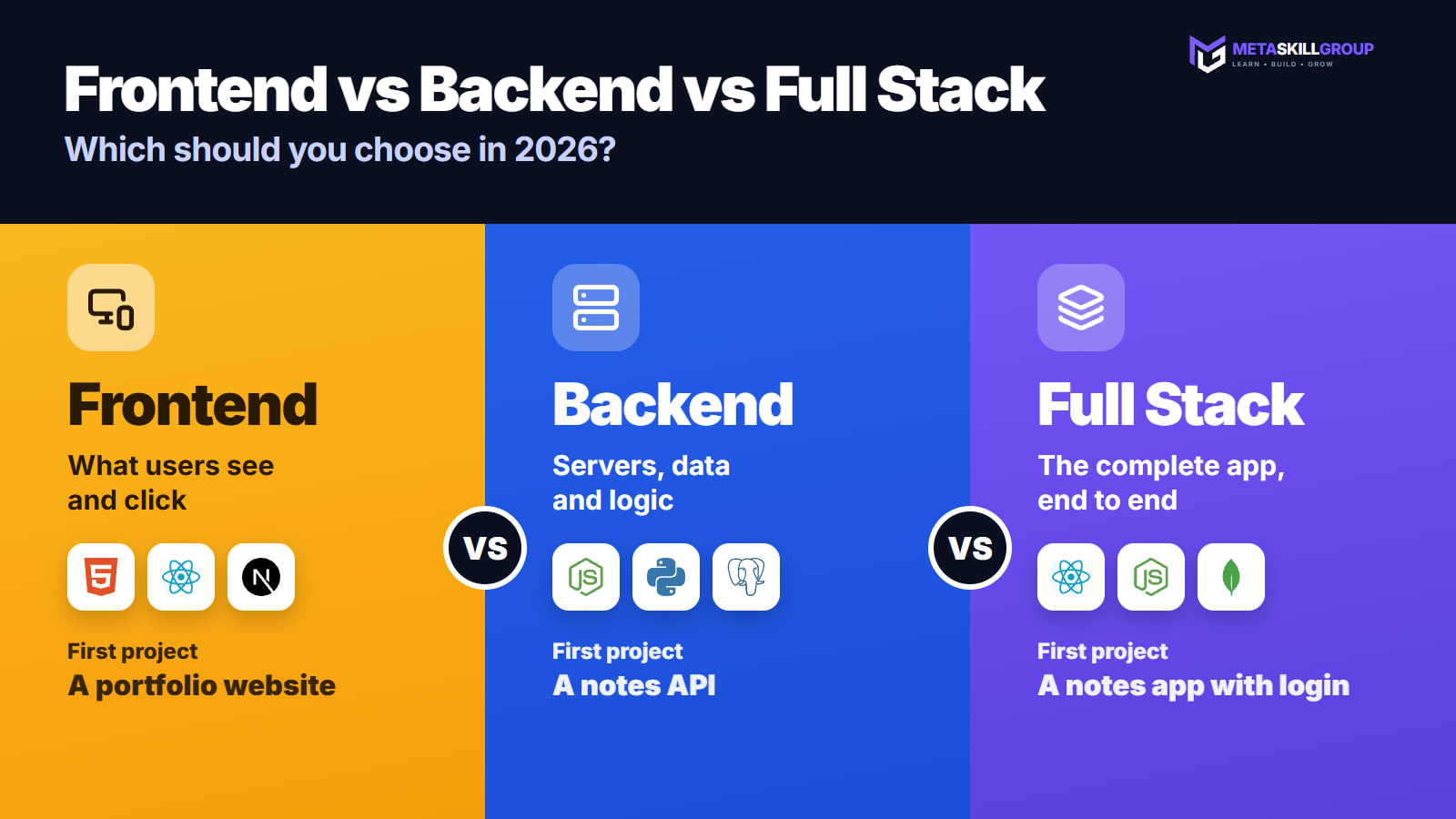
"Should I learn frontend or backend? Or should I go straight to full stack?" Almost every student asks this before writing their first real project, and many spend weeks watching comparison videos instead of starting.
Here is some good news: this choice is much less permanent than it feels. The three paths share a lot of the same basics, and plenty of developers move between them during their careers. This guide explains what each role really does, who each one suits and how to decide with a simple 30-day test.
💡 Quick answer: Frontend developers build what users see and click. Backend developers build the servers, databases and logic behind it. Full stack developers work on both. If you enjoy visual work, start with frontend. If you enjoy logic and data, start with backend. If you are unsure, learn HTML, CSS and JavaScript first, because they open the door to all three paths.
💡 Who is this guide for? Students and beginners who want to become web developers and aren't sure which path to take. You don't need any coding experience to read this.
In this guide:
- The Simple Explanation
- What Frontend Developers Do
- What Backend Developers Do
- What Full Stack Developers Do
- Side-by-Side Comparison
- One Feature, Three Views
- Which One Suits You?
- What About Pay and Demand?
- What Should a Complete Beginner Learn First?
- Where MERN, MEAN and Python Fit In
- A 30-Day Test to Help You Decide
- Common Myths
The Simple Explanation
Think of a website as a restaurant:
- Frontend is the dining area: the menu, the tables, the lighting and everything a customer sees and touches.
- Backend is the kitchen and the storeroom: customers never go there, but it is where the orders are prepared and the stock is managed.
- Full stack is someone who can work in both places, and understands how an order travels from the table to the kitchen and back.
Every real product needs all of these. No path is "better" than another; they are just different kinds of work.
What Frontend Developers Do
Frontend developers build the part of a website or app that runs in the browser. They turn designs into pages that look right on every screen and respond smoothly when you use them.
- Daily work: building pages and reusable components, connecting them to APIs, making layouts responsive and improving page speed
- Main skills: HTML, CSS, JavaScript, TypeScript, React and Next.js
- You will enjoy it if: you like seeing results instantly and care about how things look and feel
Our frontend developer roadmap shows the full path, stage by stage.
What Backend Developers Do
Backend developers build what runs on the server: the APIs, the business logic and the databases. They make sure data is correct, safe and fast to reach, even when many people use the app at once.
- Daily work: building API endpoints, designing database tables, adding login and payments, and fixing slow queries
- Main skills: Node.js or Python, SQL, MongoDB, REST APIs, security and deployment
- You will enjoy it if: you like logic, data and working out why something is broken
Our backend developer roadmap explains what to learn and what to build at each step.
What Full Stack Developers Do
Full stack developers can build a feature from the page all the way down to the database. They may not be the deepest expert in every area, but they understand how the whole system fits together, which is especially useful in startups and small teams.
- Daily work: building complete features across frontend and backend, connecting the two and deploying them
- Main skills: a frontend framework, a backend language, a database and deployment
- You will enjoy it if: you like building complete things yourself and don't mind switching between different kinds of problems
Most full stack developers start on one side and then add the other. Our MERN stack roadmap is a popular way to learn both using just one language, JavaScript.
Side-by-Side Comparison
| Frontend | Backend | Full Stack | |
|---|---|---|---|
| What you build | Pages and interfaces | APIs and databases | Complete features |
| Where it runs | In the browser | On a server | Both |
| Main languages | HTML, CSS, JavaScript, TypeScript | JavaScript, Python, Java, SQL | JavaScript or TypeScript, plus SQL |
| Popular tools | React, Next.js, Tailwind CSS | Express, FastAPI, PostgreSQL | React, Node.js, MongoDB |
| You see results | Instantly, on the screen | Through API responses and data | Both |
| Typical challenge | Making it work on every device | Keeping data safe and queries fast | Keeping track of a lot of moving parts |
| Good first project | A portfolio website | A notes API | A notes app with login |
One Feature, Three Views
The difference is easiest to see with a single feature. Here is what happens when a user logs in:

Figure 1: One login feature. Frontend, backend and full stack developers each work on different parts of it.
A frontend developer builds the form and sends the data to the server:
js1const response = await fetch("/api/login", { 2 method: "POST", 3 headers: { "Content-Type": "application/json" }, 4 body: JSON.stringify({ email, password }), 5}); 6 7if (!response.ok) { 8 setError("Wrong email or password"); 9}
A backend developer builds the route that receives that data and checks it. This is a simplified version:
js1app.post("/api/login", async (req, res) => { 2 const user = await findUserByEmail(req.body.email); 3 const isValid = user && (await verifyPassword(req.body.password, user.passwordHash)); 4 5 if (!isValid) { 6 return res.status(401).json({ message: "Wrong email or password" }); 7 } 8 res.json({ token: createToken(user.id) }); 9});
A full stack developer builds both pieces and makes sure they work together.
Which One Suits You?
Read each list and see which one sounds most like you.
Frontend may suit you if:
- You notice when a website looks bad or feels slow
- You like quick, visible progress
- You enjoy thinking about how people use things
- You don't mind fixing small details until they are right
Backend may suit you if:
- You enjoy puzzles, logic and maths-style thinking
- You like organising information
- You are curious about how big apps handle millions of users
- You are happy working without a visual result
Full stack may suit you if:
- You want to build complete apps on your own
- You like variety and get bored doing one thing
- You want to start your own product someday
- You are comfortable with learning more before you feel "expert"
💡 Pro Tip: Don't choose based on what sounds easiest. Each path has easy days and hard days. Choose the kind of problem you are happy to spend a whole evening on.

Figure 2: A quick guide to choosing where to start.
What About Pay and Demand?
This is usually the first question, and the honest answer is that this article won't give you one magic number. Salary articles online show very different figures for the same role, often without saying where they came from.
What you can rely on is this:
- At the fresher level, your skills, projects and the company usually matter more than the job title. A strong frontend developer at one company can earn more than an average backend developer at another, and the reverse is just as true.
- All three skill sets are widely used. In the 2026 Stack Overflow Developer Survey, Node.js (46.4%), React (41.5%) and Next.js (20.6%) were among the most used web technologies, and SQL was used by 58.4% of respondents.
- For real numbers, check live data. Look at current job posts and salary pages on the portals you plan to apply through, for your city and experience level.
So choose the work you can stick with. You will get good at something you enjoy much faster, and being good is what opens up better roles.
What Should a Complete Beginner Learn First?
If you are still unsure, here is our recommendation: start with HTML, CSS and JavaScript.
- You see results straight away, which keeps you motivated.
- JavaScript also runs on the server with Node.js, so nothing you learn goes to waste if you move to backend later.
- Even backend developers benefit from understanding how the frontend works.
The only exception is if you already know you are interested in data science or AI. In that case, starting with Python can make more sense, and our Python developer roadmap shows that path.
Whatever you choose, learn Git from the first week. Our Git and GitHub guide makes it simple.
Where MERN, MEAN and Python Fit In
You will often see these terms. They are not separate careers; they are specific sets of tools. Here is how they map to the three paths, along with our internship track for each:
| Track | What it covers | Good for | Internship track |
|---|---|---|---|
| Frontend | React, Next.js, TypeScript | Visual and interface work | Frontend internship |
| Backend | Node.js, Express, MongoDB, REST APIs | Server and data work | Backend internship |
| Full Stack | TypeScript, React, Node.js, MongoDB | Complete features | Full stack internship |
| MERN | MongoDB, Express, React, Node.js | JavaScript across the whole app | MERN internship |
| MEAN | MongoDB, Express, Angular, Node.js | The same idea, with Angular | MEAN internship |
| Python | Python, Django, FastAPI | Python-based backends | Python internship |
A 30-Day Test to Help You Decide
Instead of debating for months, try both for a few weeks. By the end, you will have real experience to base your decision on.
| Week | Do this | Ask yourself |
|---|---|---|
| 1 | Learn HTML and CSS, and build a simple profile page | Did I enjoy making it look right? |
| 2 | Add JavaScript: a working to-do list | Did I enjoy making it respond? |
| 3 | Build a tiny API with Node.js and Express | Did I enjoy the logic, even with no visuals? |
| 4 | Connect your to-do list to your API | Did I enjoy connecting the two? |
If week 1 and 2 felt the most fun, try frontend. If week 3 pulled you in, try backend. If week 4 was the best part, try full stack. If you enjoyed everything, start with frontend and add backend next, because that is a natural path to full stack.
Common Myths
| Myth | The reality |
|---|---|
| "Frontend is just making things pretty" | Modern frontend involves state, performance, accessibility and a lot of real programming |
| "Backend is only for maths toppers" | Clear logic matters far more than advanced maths for most backend work |
| "Full stack means being an expert in everything" | It means being able to build a complete feature, usually with one stronger side |
| "My first choice is permanent" | Many developers switch, and most of what you learn carries over |
| "I need to pick the perfect path before I start" | You will learn what you enjoy by building things, not by comparing paths |
Final Thoughts
Frontend, backend and full stack are three ways to do the same thing: build useful software. Pick the one that sounds most interesting today, or take the 30-day test, and then start building. A finished project teaches you more about what you enjoy than any comparison article, including this one.
Once you have some basics, working on a real product is the fastest way to confirm your choice. You can do a free internship at MetaSkillGroup, where you build real features and our team reviews your work. Our online developer internship is open all year in six tracks, and you can choose the one that suits you. It takes about 2 minutes to apply, and your first exam attempt is free.
- #frontend vs backend
- #full stack developer
- #frontend developer
- #backend developer
- #web developer career
- #web development internship
- #career guide for students
- #beginner guide
Related posts
 How to Get a Web Development Internship With No Experience (2026 Guide)No experience? No problem. A step-by-step 2026 guide to your first web development internship: pick one track, learn the basics in 30 days, build three small projects, set up GitHub and LinkedIn, and prepare for the entrance test.
 Free Online Internship for Students in 2026: How to Find a Real One (With Certificate)A simple 2026 guide to free online internships for students and freshers in India: what a good internship gives you, where to find one, how to get selected without experience, and how a work-from-home internship with a verifiable certificate works.
 Internship for BCA and B.Tech Students in 2026: A Simple Guide for FreshersA simple guide for BCA and B.Tech students: why an internship matters for your degree, when to do your first one, online vs office internships, which track fits your course and what to submit to your college.
❓ FAQs
Frontend developers build what users see and click in the browser. Backend developers build the servers, APIs and databases behind it. Full stack developers can work on both and build a complete feature from the page to the database.
Frontend usually feels easier at the start, because you see your results on screen straight away. Backend can suit you better if you enjoy logic and data. Both become challenging as you go deeper, so choose the one you find more interesting.
If you are unsure, start with HTML, CSS and JavaScript. You get quick visual results, and JavaScript also runs on the server with Node.js, so nothing goes to waste if you move to backend later. If you already love logic and data, starting with backend is also fine.
There is no single answer. At the fresher level, your skills, projects and the company usually matter more than the job title. For real numbers, check current job posts and salary pages for your city and experience level.
It isn't better, just broader. Full stack developers are especially useful in startups and small teams, while specialists can go deeper in one area. Many full stack developers start on one side and then add the other.
Yes. Many developers switch during their careers, and most of what you learn carries over, including Git, JavaScript, APIs and problem solving. Your first choice is a starting point, not a permanent decision.
Backend developers don't need to be experts in them, but knowing the basics helps. It makes it easier to understand how the frontend uses your API, to work with frontend teammates and to build simple test pages.
MERN is one kind of full stack. It stands for MongoDB, Express, React and Node.js, which together cover the frontend, backend and database using JavaScript. Full stack can also use other tools, such as Python with Django or Angular in the MEAN stack.
At around 2 hours a day, a beginner needs roughly 6 to 8 months to complete a full MERN roadmap. This is an estimate, and it depends on how much you already know and how many projects you build.
Yes. MetaSkillGroup offers a free online internship in six tracks: frontend, backend, full stack, MERN, MEAN and Python. You choose your track when you apply at metaskillgroup.com/careers. It takes about 2 minutes, and your first exam attempt is free.
Comments
Join the conversation
Login to post comments and replies
No comments yet. Be the first!