Tech Industry NewsDeveloper Careers
New US Green Card Rule: Why Many Indians May Have to Go Back Home to Complete Their Green Card
A May 2026 USCIS memo made it much harder to get a green card from inside the US. Officers can now treat adjustment of status as a special favour, not a normal right. Here is what changed, how it affects Indian H-1B workers and families, and the lawsuit filed against it.

MetaSkillGroup
9 min read5

For many years, most Indians in the US completed their green card without leaving America. They filed one form, waited, attended an interview if needed, and got their card in the post. Their kids continued school. Their jobs continued. Life continued.
In May 2026, the US quietly changed that. A new USCIS policy memo now treats getting a green card from inside the US as a special favour, not a normal right. The US government's public message was even sharper: if you came on a temporary visa and want a green card, go back home and apply from there.
This article explains what changed, what the memo actually says, how it affects Indian H-1B workers and families, and the lawsuit that has now been filed against it.
📌 Quick Summary
- What: USCIS policy memo PM-602-0199, issued on 21 May 2026.
- The change: Getting a green card inside the US (adjustment of status) is now treated as "extraordinary relief".
- The effect: Officers have more power to say no and push applicants towards consular processing abroad.
- Who is hit: H-1B workers, spouses of US citizens, students and many others already living in the US.
- Latest: A lawsuit was filed on 5 October 2026. The policy is still in effect.
Two Ways to Get a Green Card
Before we go into the rule, let us understand the two ways to complete a green card. This is the key to the whole story.
| Point | Adjustment of Status (AOS) | Consular Processing |
|---|---|---|
| Where it happens | Inside the US | At a US embassy or consulate abroad |
| Main form | Form I-485 | Immigrant visa application |
| Do you have to travel? | No | Yes, usually to your home country |
| Work while waiting? | Usually yes, with a work permit (EAD) | Depends on your existing visa |
| Family stays together? | Yes | Not always, there can be long separations |
| Risk | Lower | Visa delays, interview risk, travel problems |
Before May 2026, most green card applicants already living in the US used adjustment of status. In a typical year, about 10 lakh people (1 million) apply for green cards, and about half of them apply from inside the US (NBC News).
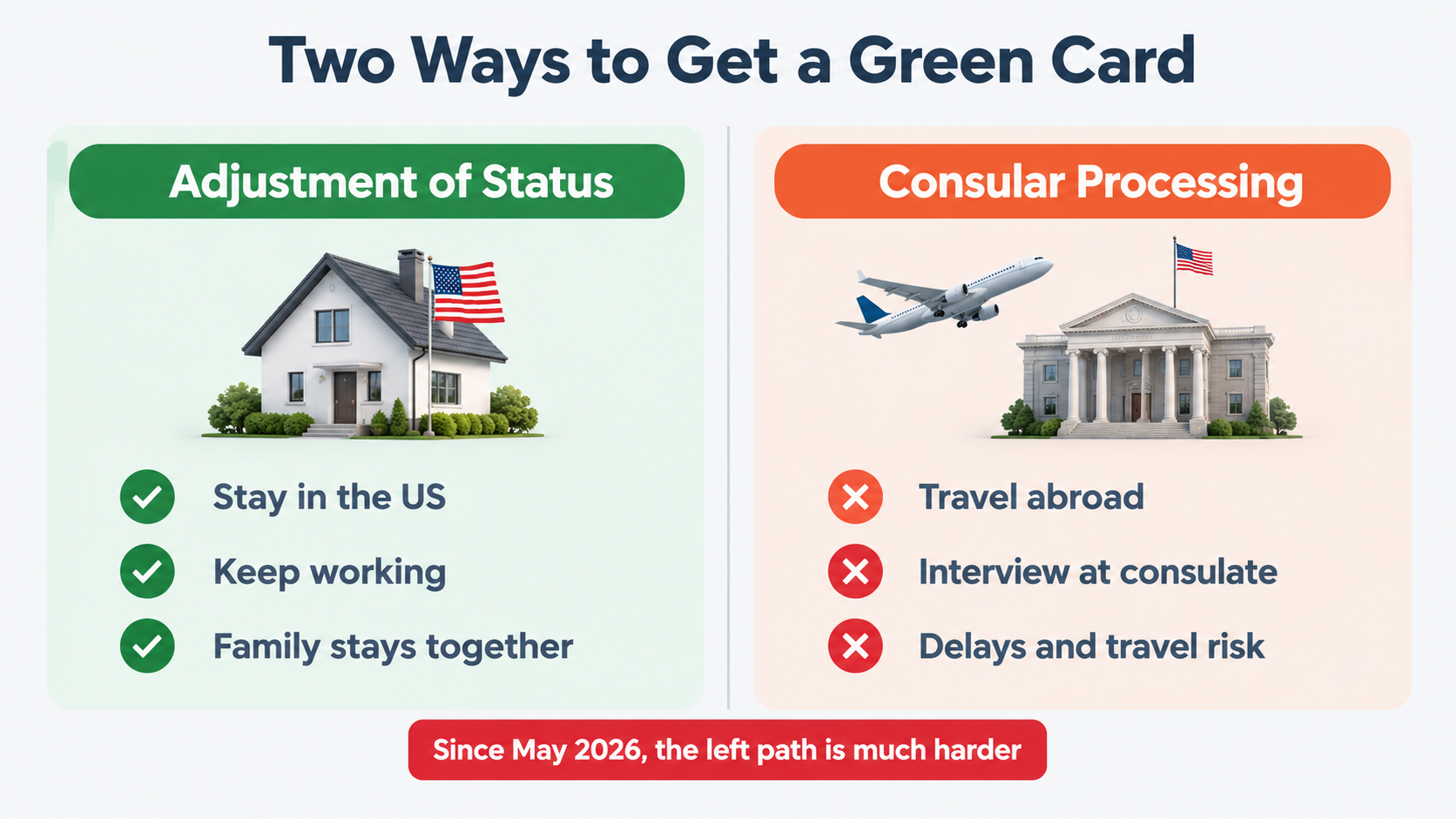
Figure 1: Adjustment of status lets you stay in the US. Consular processing means travelling abroad for an interview.
What Changed in May 2026?
On 21 May 2026, USCIS issued policy memo PM-602-0199. Its title itself tells the story. It calls adjustment of status a matter of discretion and "administrative grace", and an extraordinary relief that lets applicants skip the normal consular process (USCIS memo PDF).
In simple words, this is what the memo tells USCIS officers:
- Being eligible is no longer enough. Even if you meet every legal requirement, the officer can still say no.
- Look at the full picture. Officers must weigh all positive and negative points in every I-485 decision (Visa Pros).
- You need strong positive reasons. Applicants must show unusual or outstanding positive factors to overcome any negative ones (AILA).
- Choosing AOS can count against you. Lawyers say your choice to apply inside the US instead of abroad can now be weighed against you (Visa Pros).
On 22 May, the US government went further in public. It said people on temporary visas who want a green card must return to their home countries and apply through consular processing, except in extraordinary circumstances (NBC News).
What the Memo Says vs What People Heard
This part is important, because there is a lot of confusion online.
- The public message from the US government was: go home and apply from there.
- The memo itself, according to many immigration lawyers, does not legally ban adjustment of status and does not force anyone to use consular processing (Lexelite).
So the correct way to understand it is this: adjustment of status still exists, but it has become much harder and much more uncertain. Officers now have a lot more power to deny it, and the government has made it clear which path it prefers.
💡 What this means in practice: Lawyers report that USCIS is applying the memo to pending applications too, which is why many applicants who filed before May 2026 are now seeing more interviews and more requests for evidence (Visa Pros).
Why This Hurts Indians the Most
1. Indians wait the longest
Because of the per-country limit, Indians have the longest employment-based green card queue in the world. In the October 2026 Visa Bulletin, the final action date for EB-2 India is 1 November 2013 and for EB-3 India is 1 January 2014 (American Visa Law Group).
That means many Indians have spent 10 to 15 years in the US on H-1B before their turn comes. By then, they have homes, cars, careers and children who have grown up as Americans. Asking them to fly back to India for the final step is not a small thing.
2. Travel brings real risk
Going abroad for consular processing means:
- Waiting for an interview slot at a US consulate, which can take time.
- Security checks and delays that can stretch for weeks or months.
- Separation from family, if the spouse or children are on different timelines.
- Job risk, if your employer cannot keep your role open while you are away.
For people with any gap in their status, leaving the US can be even more dangerous. Lawyers warn that gaps can create "unlawful presence", and leaving the US after that can trigger 3-year or 10-year bans on returning (Lexelite).
3. Families get split
This rule does not only affect H-1B workers. It also affects spouses of US citizens, students, refugees and asylum seekers who were all able to complete the process inside the US before (PBS). Critics have warned that the policy will separate husbands from wives and children from parents (NBC News).

Figure 2: For many Indian families, the final step of the green card may now mean a long trip away from home.
The Lawsuit: Is There Hope?
Yes, there is some hope.
On 5 October 2026, a lawsuit was filed in the US District Court for the District of Massachusetts. The people suing include university professors' groups (AAUP and its Harvard and Boston University chapters), the labour union SEIU, a legal aid group called Americans for Immigrant Justice, and seven green card applicants whose cases were pending or denied (court complaint, via American Immigration Council). The case challenges two USCIS policies:
- PM-602-0199 (21 May 2026), the adjustment of status memo.
- PA-2026-05 (5 August 2026), a policy that allows USCIS to deny an application when required evidence is missing, without first sending a request for more evidence. It also applies to applications that were already pending (court complaint).
The groups argue that these policies go beyond what US law allows, break the Administrative Procedure Act, and violate the right to due process. They are asking the court for a preliminary injunction, which means a temporary block, and finally to cancel the policies (Visas Update).
But remember: filing a lawsuit does not stop the policy by itself. Both policies remain in effect while the case continues (Visas Update).
⚠️ Note: This is a developing story. The court may or may not block the policy. Check for updates before taking any decision.
What Should You Do Right Now?
If you are an Indian H-1B worker, a spouse, or anyone with a pending or planned green card in the US:
- Don't travel without legal advice. Leaving the US at the wrong time can create serious problems.
- Keep your status clean. Any gap in your visa status can now hurt you more than before.
- Prepare a strong file. Since officers now look for strong positive points, keep proof of your job, tax payments, home, family ties, community work and clean record ready.
- Talk to an immigration lawyer before choosing between adjustment of status and consular processing.
- Respond to every USCIS request quickly and fully. Under the August 2026 directive, some cases can be denied without a second chance.
- Follow the lawsuit. If the court blocks the policy, the situation can change quickly.
Final Thoughts
For decades, adjustment of status was the normal, humane way to finish a green card for people already living and working legally in the US. It let families stay together while the paperwork was completed. The new memo turns that normal path into a favour that officers can give or take away.
For Indians, who already wait longer than anyone else, this adds one more layer of uncertainty at the very end of a very long journey.
This rule is one part of a much bigger set of changes in 2026. To understand the full picture, read our complete guide: US Green Card Guide for Indian Students and Tech Professionals (2026). You can also read about the suspension of Infosys, TCS and Microsoft from green card sponsorship and the proposed $70,000 OPT fee for students.
🚀 Build a career that is not stuck in a visa queue
The MetaSkillGroup Internship is fully remote. Work on real-world web and app projects, learn from experienced developers, and build skills that you can use from anywhere in the world.
- #green card
- #adjustment of status
- #consular processing
- #uscis
- #h-1b
- #us immigration
- #indian professionals
- #us visa news
❓ FAQs
On 21 May 2026, USCIS issued a policy memo called PM-602-0199. It tells officers to treat getting a green card from inside the US (adjustment of status) as a special favour, not a normal right. Applicants now have to show strong positive reasons for approval.
Not automatically. USCIS publicly said temporary visa holders should return home to apply, except in extraordinary cases. But lawyers point out that the memo itself does not legally ban adjustment of status. It gives officers much more power to say no, and pushes people towards consular processing abroad.
Adjustment of status means you complete your green card inside the US by filing Form I-485. Consular processing means you go to a US embassy or consulate outside the US, usually in your home country, for an interview to get an immigrant visa.
Immigration lawyers report that USCIS is applying the memo to pending I-485 applications too, which is why many applicants are seeing more interviews and evidence requests. The lawsuit filed in October 2026 is also challenging this.
Not yet. A lawsuit was filed on 5 October 2026 in a federal court in Massachusetts by university professors' groups, the SEIU labour union, a legal aid group and seven green card applicants. The policy stays in effect while the case continues.
Do not decide this on your own. Consular processing can bring delays, travel risk and time away from family and work. Always speak to an immigration lawyer before choosing a path or travelling.
Comments
Join the conversation
Login to post comments and replies
No comments yet. Be the first!