Web DevelopmentCyber Law for DevelopersOnline Safety
Rape Videos, "Forced" Porn, Revenge Porn and Deepfake Nudify Apps: Why Developers Who Build or Host Them Go to Jail in India
Rape videos, forced porn, revenge porn, hidden-camera footage and AI deepfake nudes are serious crimes in India. Learn the punishments under IT Act 66E and 67A, BNS 77 voyeurism and BNS 64 rape, the 2026 IT Rules 2-hour takedown, MeitY's action on Grok, and real cases including a life sentence, a revenge porn conviction, the Rajkot CCTV racket and a 2026 deepfake arrest.

MetaSkillGroup
17 min read7
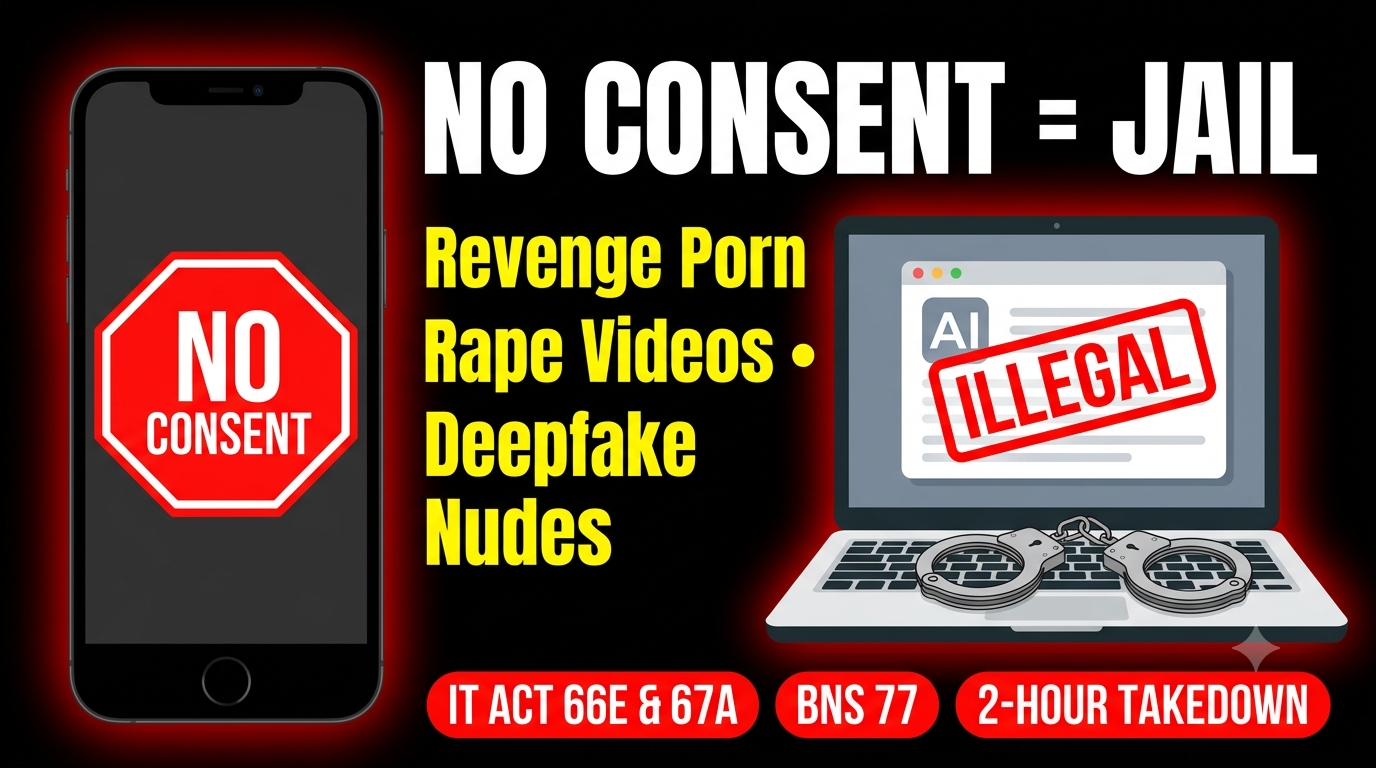
Quick answer: In India, recording, uploading or sharing rape videos, "forced" porn, revenge porn, hidden-camera footage or deepfake nudes is a serious crime. Sharing someone's private images without consent attracts IT Act 66E (up to 3 years), IT Act 67A (up to 5 years and ₹10 lakh) and BNS 77 voyeurism (1 to 3 years, rising to 3 to 7 years on repeat). The underlying rape carries a minimum of 10 years under BNS 64, and 20 years for gang rape. In 2025 a former MP who recorded his assaults was sentenced to life imprisonment. Developers who build or host platforms, bots or "nudify" apps for such content can be prosecuted too.
Last updated: October 2026
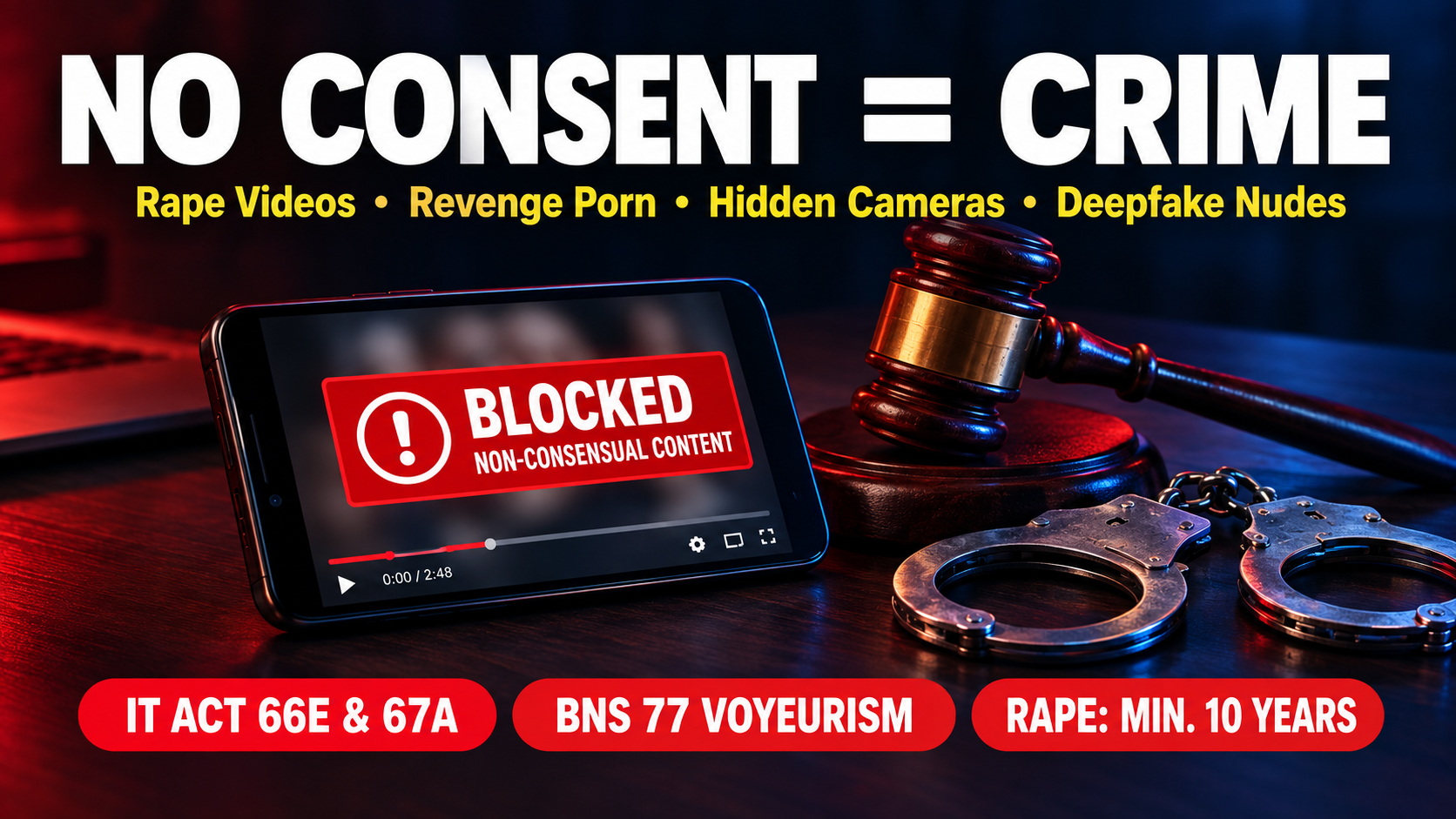
Most "adult content" debates are about whether something is obscene. This article is about something far worse: content where at least one person never agreed to be filmed, to be shared, or to appear at all.
Rape videos, so-called "forced" category porn, revenge porn, leaked private videos, hidden-camera footage, hacked CCTV clips and AI-generated deepfake nudes all have one thing in common: a real victim. That is why Indian police, courts and the government treat them as some of the most serious online crimes, and why the people who build the tools and platforms that spread them are increasingly in the dock.
If you are a developer, this applies to you whenever you build anything that can upload, stream, sell, generate or edit images and videos of real people: a tube-style video site, a Telegram bot, a face-swap or "AI undress" app, a CCTV or IoT camera product, or even a simple file-sharing tool.
This article is part of our series Running an Adult Website in India as a Developer: Laws, Punishments, Real Arrests and Why You Will Get Caught.
What Counts as Non-Consensual Content?
Non-consensual content is any intimate or sexual image or video of a real person that was recorded, shared, altered or generated without that person's consent. It includes:
- Rape videos: recordings of an actual sexual assault
- "Forced" or "non-consent" category porn: content marketed as showing someone being forced, whether real or staged
- Revenge porn: private images or videos shared by an ex-partner or someone else to humiliate, punish or blackmail
- Leaked private videos: intimate content stolen from a phone, cloud account or chat
- Hidden-camera and hacked CCTV footage: recordings from changing rooms, hotel rooms, hospitals or homes
- Deepfake nudes and "nudify" images: AI-generated or morphed images that place a real person's face or body into sexual content
In India, the legal term most used by courts and the government is NCII: Non-Consensual Intimate Images.
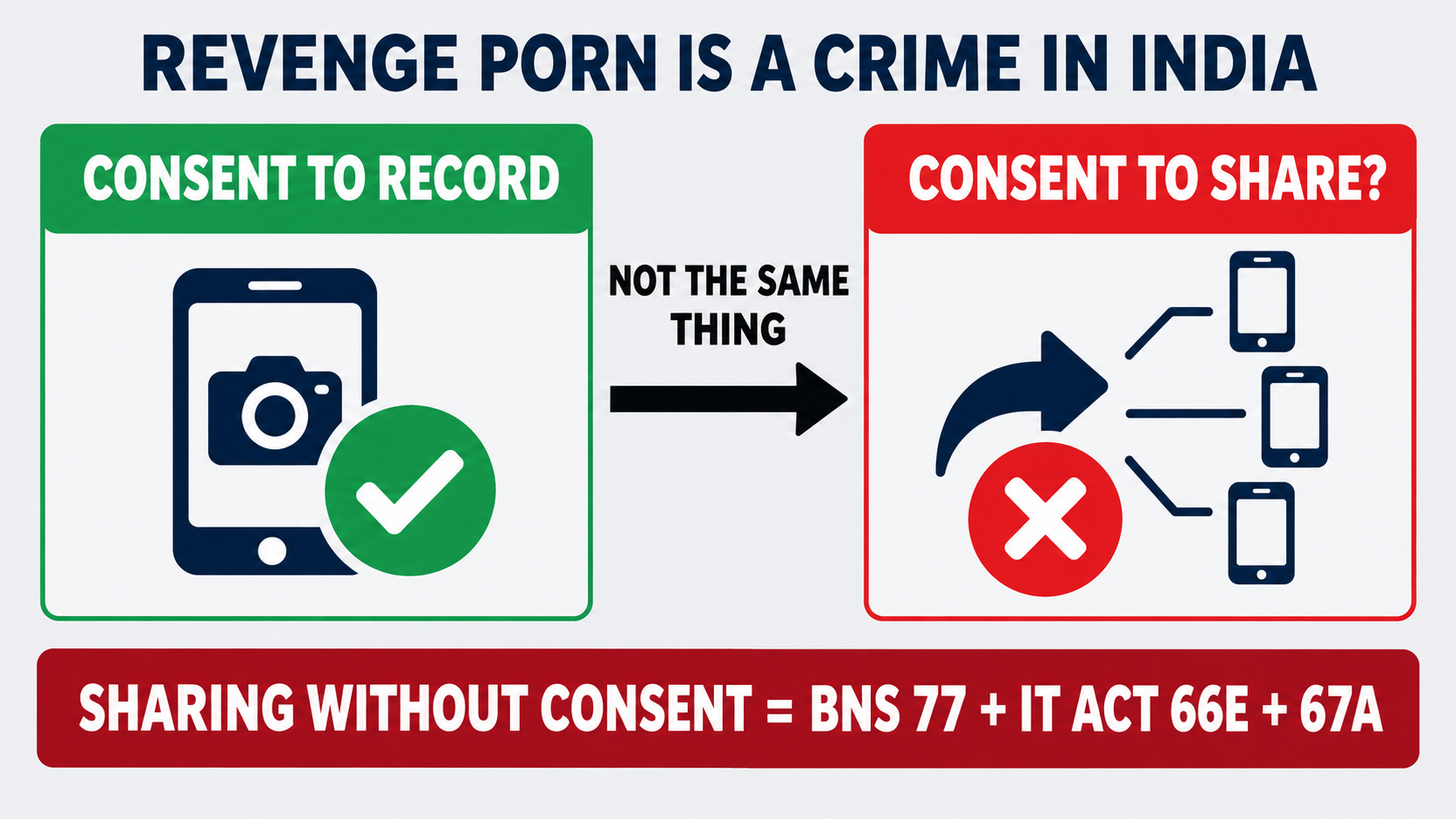
Consent to record is not consent to share. Even if a person agreed to be photographed or filmed in private, sharing that content with anyone else without their consent is a separate crime under Indian law.
The Laws That Apply
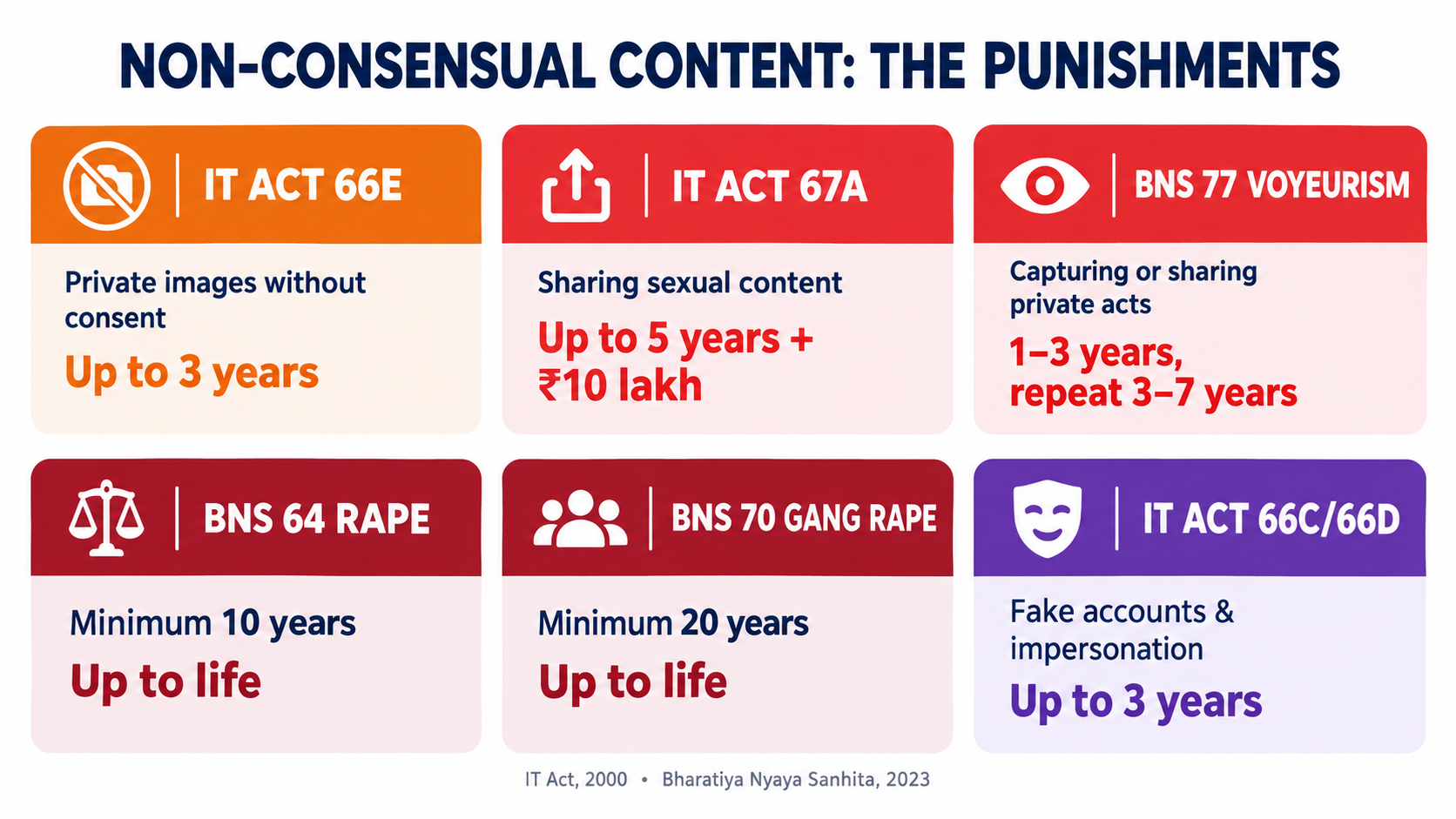
There is no single "revenge porn law" in India. Instead, police combine several sections from the IT Act and the Bharatiya Nyaya Sanhita (BNS). In practice, a single case can involve five or six of these at once.
| Law and Section | What it covers | Punishment |
|---|---|---|
| IT Act 66E | Capturing, publishing or transmitting images of a person's private area without consent | Up to 3 years, or fine up to ₹2 lakh, or both |
| IT Act 67 | Publishing or transmitting obscene material | Up to 3 years + up to ₹5 lakh (up to 5 years on repeat) |
| IT Act 67A | Publishing or transmitting sexually explicit material | Up to 5 years + up to ₹10 lakh (up to 7 years on repeat), non-bailable |
| BNS 77 (Voyeurism) | Watching, capturing or disseminating images of a woman in a private act | 1 to 3 years + fine; 3 to 7 years on repeat |
| BNS 72 | Publishing anything that reveals the identity of a rape or sexual assault victim | Up to 2 years + fine |
| BNS 64 (Rape) | Rape | Minimum 10 years, up to life imprisonment + fine |
| BNS 70 (Gang rape) | Gang rape | Minimum 20 years, up to life imprisonment + fine |
| IT Act 66C / 66D | Identity theft and cheating by impersonation using fake accounts | Up to 3 years + fine |
| IT Act 67B + POCSO | Any of the above involving a person under 18 | See our CSAM article, with minimum jail terms |
Depending on the facts, police also add BNS sections on stalking, criminal intimidation, extortion (for sextortion), insulting the modesty of a woman and criminal conspiracy.
For the full breakdown of IT Act 67, 67A and 67B, read Porn Laws in India Every Developer Must Know.
Rape Videos and "Forced" Porn
Why this is the most serious category
A real rape video is not "content". It is evidence of a violent crime and a permanent violation of the victim every time it is viewed or shared. Everyone in the chain faces prosecution:
- The person who commits and records the assault faces rape charges (minimum 10 years, minimum 20 for gang rape) plus IT Act and voyeurism charges for recording it.
- Anyone who uploads, shares, forwards or sells it faces IT Act 66E, 67A and BNS 77.
- Anyone whose post or upload reveals the victim's identity faces BNS 72.
- A website or channel that hosts or monetises it is publishing sexually explicit material and can be charged under IT Act 67A, along with conspiracy.
What about "staged" forced content?
Some sites claim their "forced" or "non-consent" category videos are acted. That does not make them legal in India. Publishing any sexually explicit material online is already an offence under IT Act 67A. And the platform has no way of proving every performer actually consented, which is exactly why such categories are where real rape videos and trafficking victims end up being hidden.
Real case: life imprisonment for a former MP who recorded his assaults
In April 2024, pen drives containing explicit videos began circulating in Hassan, Karnataka, ahead of the Lok Sabha elections. The videos allegedly showed sexual assaults recorded by Prajwal Revanna, then a sitting Member of Parliament.
On 2 August 2025, a Special Court in Bengaluru sentenced him to life imprisonment and a total fine of ₹11.5 lakh (most of it as compensation to the victim) for raping a domestic worker in 2021. The court found that he had recorded the assaults on his mobile phone. He was convicted under the rape and sexual harassment sections of the IPC and Section 66E of the IT Act for violating the victim's privacy. He has since appealed the conviction in the Karnataka High Court.
The lesson: the video he recorded became part of the evidence that convicted him. Recording such acts does not create "content". It creates proof.
Revenge Porn and Leaked Private Videos
What the law says
Sharing an ex-partner's intimate images, whether to take revenge, to blackmail, or "just to show friends", can attract:
- IT Act 66E for transmitting images of a person's private area without consent
- IT Act 67 and 67A for publishing obscene and sexually explicit material
- BNS 77 for voyeurism, which explicitly covers dissemination even when the person had agreed to the original photo or video
- Extortion and criminal intimidation sections if the images were used to threaten or demand money (sextortion)
- IT Act 66C if a fake profile was created in the victim's name
Real case: 5 years in jail for uploading an ex-girlfriend's videos
In March 2018, a court in Tamluk, East Midnapore (West Bengal) delivered one of India's first convictions in a revenge porn case. The accused, a 23-year-old man, had obtained private videos from his girlfriend's phone, blackmailed her, and after she ended the relationship, uploaded the videos to porn websites in 2017 along with her name and her father's details.
The court sentenced him to 5 years in jail and fined him, under IT Act 66E, 66C, 67 and 67A along with IPC sections on sexual harassment, voyeurism and insulting a woman's modesty. The judge also directed the state to treat the victim as a rape survivor for compensation purposes.
Courts are now forcing platforms to act fast
In April 2023, in Mrs X v. Union of India, the Delhi High Court issued detailed directions on NCII after a woman struggled to get her intimate images removed from the internet. The court:
- Warned that search engines and platforms that miss IT Rules takedown deadlines lose their safe harbour protection under Section 79
- Directed the creation of a trusted, encrypted system to register offending content so it can be automatically blocked from reappearing
- Directed improvements to cybercrime.gov.in, including complaint status tracking
Since 20 February 2026, the amended IT Rules require platforms to remove non-consensual intimate imagery, including deepfakes, within 2 hours of a complaint.
Hidden Cameras and Hacked CCTV Footage
This category is especially relevant to developers, because it often involves hacking poorly secured systems.
Real case: hacked hospital CCTV videos sold on Telegram
In February 2025, Gujarat Police registered a case after videos of women patients being examined in the labour room of a maternity home in Rajkot were found being sold online. Investigators found that hackers had gained access to the hospital's CCTV system. The footage was then sold through subscription-based Telegram groups, reportedly at around ₹2,000 per video, and promoted through YouTube channels that linked viewers to private Telegram groups. Some of the footage was converted into QR codes for sale.
By the time of the seventh arrest, police said the accused had compromised around 50,000 CCTV cameras across hospitals, offices, schools, colleges and even residential bedrooms. The accused were charged with criminal conspiracy, voyeurism under the BNS, and cyber terrorism under IT Act Section 66F, an offence that carries up to life imprisonment.
Two lessons for developers:
- If you sell, host or promote such footage, "it was already online" is no defence. The YouTube channel operators and Telegram sellers were arrested along with the hackers.
- If you build CCTV, IoT or camera products, weak default passwords and insecure remote access put real people at risk. Secure-by-default is not optional.
Deepfake Nudes and "Nudify" Apps
AI has made this the fastest-growing category of non-consensual content. Anyone's public Instagram photo can be turned into a fake nude in seconds. Indian law and enforcement are catching up quickly.
What the law says
Creating or sharing a sexual deepfake of a real person can attract:
- IT Act 66E, 67 and 67A for publishing private, obscene or sexually explicit images
- BNS 77 voyeurism and provisions on insulting a woman's modesty and defamation
- IT Act 66C and 66D when fake accounts are used to spread them
- IT Act 67B and POCSO if the person depicted is, or appears to be, under 18
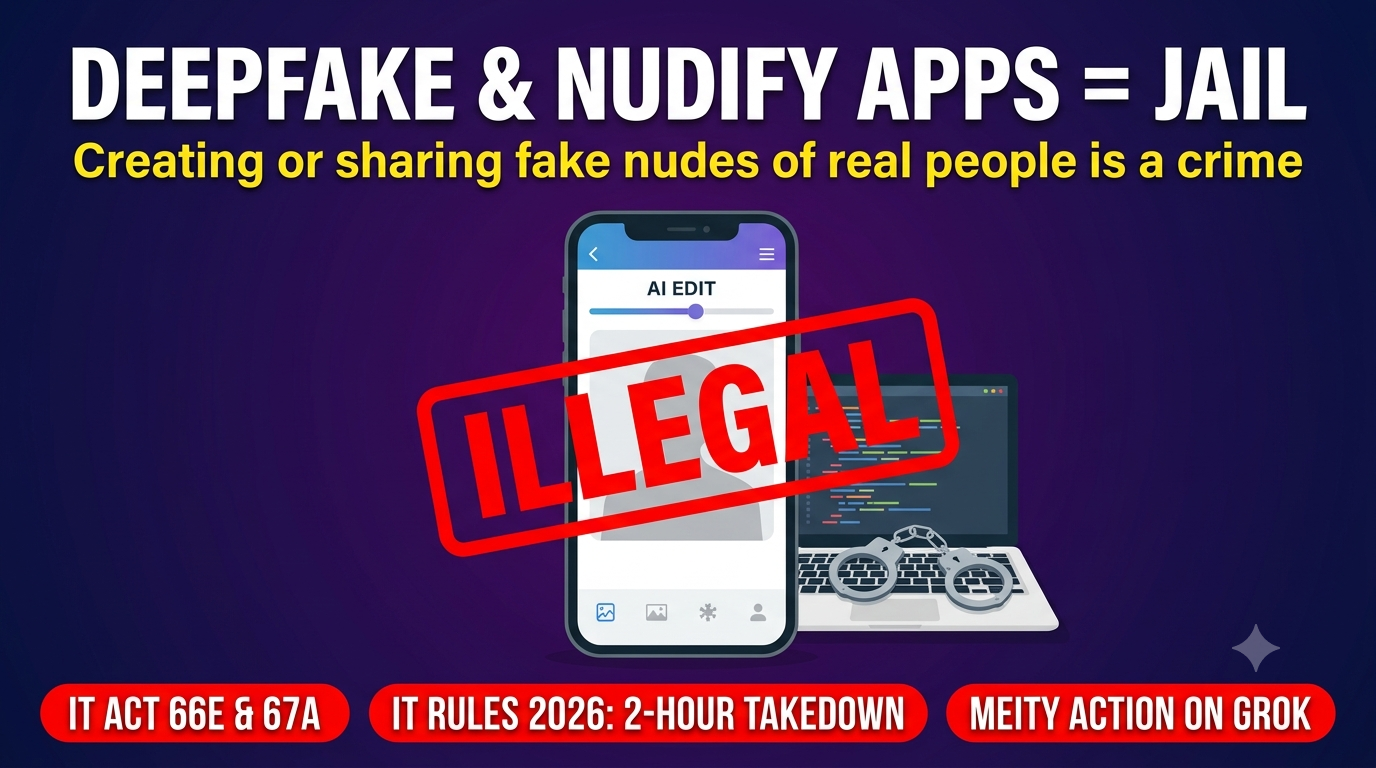
Since 20 February 2026, the amended IT Rules treat AI-created or altered content as "synthetically generated information". Platforms must label it, act on complaints about deepfake nudity within 2 hours, and, if they offer AI generation tools, deploy technical measures to stop users from generating non-consensual intimate images, obscene content or CSAM.
Real case: the government vs Grok, January 2026
On 2 January 2026, after users began using X's Grok AI to generate sexualised images of real people, the Ministry of Electronics and IT (MeitY) directed X to immediately stop the hosting, generation and sharing of obscene, nude and sexually explicit content created through Grok or similar tools, review Grok's safeguards, suspend violating users, and submit an action-taken report within 72 hours. MeitY's Secretary made it clear that platforms cannot escape responsibility simply by pleading safe harbour.
If the government will act against one of the largest AI platforms in the world, an unknown "nudify" app built by a solo developer has no chance.
Real case: B.Tech graduate arrested for AI deepfakes, September 2026
On 9 September 2026, the Cyber Police Station, North District, Delhi Police arrested a 22-year-old B.Tech graduate from West Delhi for allegedly creating and circulating obscene AI-generated images of a woman he knew from college, using photos from her private Instagram account.
According to police, he used AI image-generation and editing tools, and spread the images through multiple fake Instagram, Discord and Facebook accounts and several Gmail IDs to stay anonymous. It did not work. Police traced him by analysing digital footprints, social media accounts, email IDs and other technical evidence, and seized his phone and SIM cards.
An engineering degree, AI tools, fake accounts and multiple Gmail IDs did not protect him. Read why in Using a Foreign Gmail, US Phone Number or VPN to Run a Porn Website From India? Why You Will Still Be Caught.
Real case: the Rashmika Mandanna deepfake, January 2024
In late 2023, a deepfake video of actor Rashmika Mandanna went viral and triggered a national debate on AI misuse. On 20 January 2024, Delhi Police arrested the person behind it after scanning more than 500 social media accounts that had posted the video. Police said his motive was simply to increase his followers.
If you are building an AI image app
If you are a developer building anything with image generation, face-swap or "undress" features:
- An app whose main purpose is to create nude images of real people without their consent is a tool for committing a crime. Building, promoting or monetising it exposes you to charges for abetting every offence committed with it.
- Under the 2026 IT Rules, platforms offering AI generation must block the creation of non-consensual intimate content and CSAM, and label synthetic content.
- App stores and payment providers increasingly remove such apps, which means the money trail also leads straight to you.
Where Does a Developer Stand?
| What you build | Legal risk |
|---|---|
| A tube site with a "forced", "leaked", "hidden cam" or "revenge" category | Publishing sexually explicit and non-consensual content: IT Act 66E, 67A, BNS 77, conspiracy. No safe harbour. |
| A Telegram bot or paid group selling leaked or hacked videos | Same as above, plus commercial distribution. This is exactly what the Rajkot CCTV accused did. |
| A "nudify", "undress" or face-swap app for real people's photos | Abetment of every offence committed with the app, plus direct liability if you host or distribute the outputs. |
| A general upload or social platform that ignores NCII complaints | Loss of safe harbour under Section 79 for missing the 2-hour takedown rule. |
| A CCTV or IoT camera product with weak default security | Real-world harm, regulatory trouble and reputational damage if it becomes the entry point for voyeurism rackets. |
| A platform with consent verification, fast reporting, hash-blocking and quick takedowns | Protected. This is how responsible platforms operate. |
Common Myths
| Myth | Reality |
|---|---|
| "She sent it to me, so I can share it." | BNS 77 says consent to capture is not consent to share. Sharing is a separate crime. |
| "It's fake, it's AI, not her real body." | Deepfake nudes attract IT Act 66E, 67, 67A, defamation and modesty provisions. The 2026 IT Rules specifically target them. |
| "The 'forced' video is staged, so it's fine." | Publishing any sexually explicit content online is already an offence under IT Act 67A. |
| "I only forwarded it in a group." | Forwarding is transmitting. Every forward is a fresh offence under the IT Act. |
| "I used fake accounts and multiple Gmail IDs." | The Delhi Police traced a 22-year-old through exactly that in September 2026. |
| "It was already online, I just reposted it." | The YouTube and Telegram sellers in the Rajkot CCTV case were arrested along with the hackers. |
If You or Someone You Know Is a Victim
- Report it on cybercrime.gov.in under the category for crimes against women and children. You can also call the national cybercrime helpline 1930 or approach the nearest cyber police station.
- Report the content to the platform using its NCII or privacy complaint option. Under the 2026 IT Rules, platforms must act on such complaints within 2 hours.
- Use StopNCII.org, a free tool supported by major platforms that creates a digital fingerprint (hash) of your intimate image on your own device, so participating platforms can block it, without you having to upload the image anywhere.
- Do not pay anyone who threatens to leak your images. Save the threats as evidence and report them.
- It is not your fault. The law is on your side, and the people who shared it are the ones committing a crime.
Key Takeaways
- No consent = crime. Recording, sharing, selling or generating intimate content of a real person without consent is illegal in India.
- Consent to record is not consent to share under BNS 77.
- Rape carries a minimum of 10 years, and gang rape a minimum of 20 years. Recording it only adds charges and evidence. A former MP got life imprisonment in 2025.
- Revenge porn has led to convictions with 5 years in jail.
- Hacked CCTV footage sellers were charged with cyber terrorism in the Rajkot case.
- Deepfake nudes are covered by the IT Act and the 2026 IT Rules, with a 2-hour takedown window. MeitY acted against Grok in January 2026, and Delhi Police arrested a B.Tech graduate in September 2026.
- Developers who build platforms, bots or apps for such content are not "just developers". They are part of the crime.
Read the full series
- Running an Adult Website in India as a Developer: Laws, Punishments, Real Arrests and Why You Will Get Caught
- Porn Laws in India Every Developer Must Know: IT Act 67, 67A, 67B, POCSO and BNS Punishments Explained Section by Section
- Building Any Platform That Hosts Child Pornography (CSAM) in India: Laws, Jail Terms and Why Developers and Owners Are Held Liable
- Real Arrests in India for Running Porn Websites and Sharing Illegal Content: Cases That Prove the Law Is Enforced
- Can You Hide a Porn Website on Vercel, Render or Offshore Servers? How Indian Police Trace Website Owners
- Using a Foreign Gmail, US Phone Number or VPN to Run a Porn Website From India? Why You Will Still Be Caught
- Can You Earn Money From Ads on an Adult Website in India? The Legal and Financial Truth for Developers
Disclaimer: This article is for general awareness and educational purposes only and does not constitute legal advice. Cases described as arrests are at the investigation or trial stage unless a conviction is stated, and every accused person is presumed innocent until proven guilty. For advice on a specific situation, consult a qualified lawyer.
Sources
- Former MP Prajwal Revanna gets life sentence for sexually assaulting domestic help — The Tribune
- Prajwal Revanna challenges his conviction in Karnataka HC — The Tribune
- Man getting 5 years in jail for sharing nude video of ex — DailyO
- Delhi HC issues directions on non-consensual intimate images — LiveLaw
- Mrs X vs Union of India (2023) — Indian Kanoon
- Seventh arrest in Gujarat hospital CCTV videos case — Deccan Herald
- India directs X to curb AI-generated sexual content — MediaNama
- Delhi: 22-year-old arrested for circulating obscene AI deepfake images of woman — ANI
- Culprit behind deepfake video of actor Rashmika Mandanna arrested — Deccan Herald
- MeitY notifies the IT Amendment Rules 2026 — Khaitan & Co
- Section 66E, IT Act — Income Tax Department of India
- Section 77 BNS: Voyeurism — ApniLaw
- Section 72 BNS — LawRato
- #revenge porn law india
- #deepfake law india
- #non-consensual intimate images
- #it act section 66e
- #bns section 77 voyeurism
- #nudify apps
- #ai deepfake arrest
- #cyber law india
- #developer legal guide
- #it rules 2026
❓ FAQs
Comments
Join the conversation
Login to post comments and replies
No comments yet. Be the first!