Web DevelopmentCyber Law for Developers
Porn Laws in India Every Developer Must Know: IT Act 67, 67A, 67B, POCSO and BNS Punishments Explained Section by Section.
A section-by-section guide to porn laws in India for developers. Learn the exact jail terms and fines under IT Act Sections 67, 67A and 67B, POCSO Sections 14 and 15, BNS Section 294 and the Indecent Representation of Women Act, which offences are non-bailable, what the Supreme Court said in 2024, and why building or hosting an adult website can land a developer in jail.

MetaSkillGroup
18 min read11
Quick answer: In India, publishing, hosting or transmitting pornographic content online is a criminal offence. Under the IT Act, Section 67 (obscene content) carries up to 3 years in jail and a ₹5 lakh fine, Section 67A (sexually explicit content) up to 5 years and ₹10 lakh, and Section 67B (child sexual abuse material) up to 5 years and ₹10 lakh, rising to 7 years on a repeat conviction. Child-related content also attracts POCSO, where the minimum sentence for using a child for pornographic purposes is 5 years. If you build, deploy or run the website, the law treats you as the person who "causes" the content to be published.
Last updated: October 2026
If you are a developer in India, you have probably seen the "easy money" idea floating around in college hostels, Telegram groups and YouTube comments: build an adult website, drive traffic, put ads on it, earn passively. It sounds like just another side project. It is not.
This guide explains, section by section, which Indian laws apply to anyone who builds, hosts or runs a porn website or app, what the exact punishments are, which offences are bailable and which are not, and why "I only wrote the code" is not a defence.
This article is part of our series Running an Adult Website in India as a Developer: Laws, Punishments, Real Arrests and Why You Will Get Caught.
Is Porn Legal in India?
Watching adult pornography privately is not a crime in India. Publishing, hosting, selling or distributing it is.
This is the single most important distinction, and most people get it wrong.
- In September 2023, the Kerala High Court quashed a case against a man who was watching porn privately on his phone. The court held that private viewing, without showing it to others or distributing it, is a matter of personal choice and is not an offence under the old obscenity law (Section 292 IPC).
- The same judgment made it clear that the offence begins the moment a person circulates, distributes or publicly exhibits such material.
A website is, by definition, public exhibition and distribution. The moment you deploy a site that serves explicit content to visitors, you have crossed from "private viewing" into "publishing and transmitting", and that is exactly what Indian law punishes.
Important exception: There is no private-viewing protection for child sexual abuse material. Watching, downloading or storing it is itself a crime. We cover this in detail in the Section 67B and POCSO sections below.
The Laws That Apply to Porn Websites in India
Five main laws come into play. A single website can attract several of them at the same time.
| Law | Key Sections | What It Covers |
|---|---|---|
| Information Technology Act, 2000 | 67, 67A, 67B | Publishing or transmitting obscene, sexually explicit and child sexual abuse material in electronic form |
| POCSO Act, 2012 | 14, 15 | Using children for pornographic purposes; storing or possessing child sexual abuse material |
| Bharatiya Nyaya Sanhita, 2023 (BNS) | 294 | Selling, distributing, exhibiting or advertising obscene material, now explicitly including electronic content |
| Indecent Representation of Women (Prohibition) Act, 1986 | 3, 4, 6 | Indecent depiction of women in publications and advertisements |
| IT Rules, 2021 (amended 2026) | Rule 3 | Takedown duties for platforms, including a 2-hour window for non-consensual intimate imagery |
Let's go through each one.
Section 67 IT Act: Publishing Obscene Material
What does Section 67 cover?
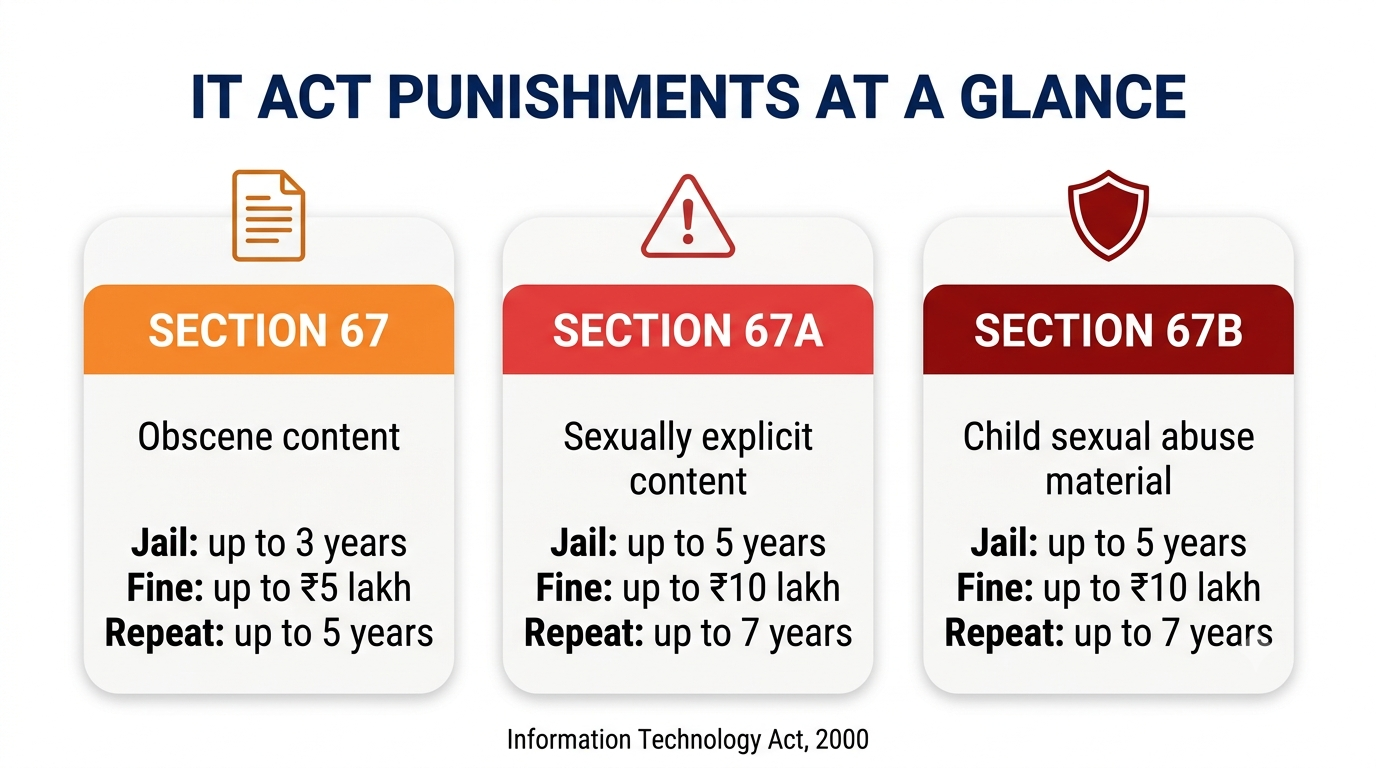
Section 67 punishes anyone who publishes, transmits, or causes to be published or transmitted any obscene material in electronic form. "Obscene" here means content that is lascivious, appeals to prurient (sexual) interest, or tends to deprave and corrupt the people likely to see it.
Indian courts judge obscenity using the contemporary community standards test, laid down by the Supreme Court in Aveek Sarkar v. State of West Bengal (2014). The question is how an average person, applying today's standards, would view the content as a whole.
What is the punishment under Section 67?
| Conviction | Jail Term | Fine |
|---|---|---|
| First conviction | Up to 3 years | Up to ₹5 lakh |
| Second or subsequent conviction | Up to 5 years | Up to ₹10 lakh |
Why "causes to be published" matters for developers
Notice the words "causes to be published or transmitted". You do not have to personally upload a single video. If you built the platform, configured the server, wrote the upload pipeline and pushed the deploy, you are the one who caused the content to be published.
India's first conviction under Section 67 came in State of Tamil Nadu v. Suhas Katti (2004), where the accused was convicted for posting obscene messages about a woman online. That was more than twenty years ago. Enforcement capability has only grown since.
Section 67A IT Act: Sexually Explicit Content
What does Section 67A cover?
Section 67A was added in 2008 and targets material containing a sexually explicit act or conduct. This is the section that directly covers pornographic videos, images and animated or drawn explicit content. The law says "any material", so it does not matter whether the content is filmed, AI-generated, 3D-rendered or a cartoon.
A typical adult video website falls squarely under Section 67A.
What is the punishment under Section 67A?
| Conviction | Jail Term | Fine |
|---|---|---|
| First conviction | Up to 5 years | Up to ₹10 lakh |
| Second or subsequent conviction | Up to 7 years | Up to ₹10 lakh |
Is Section 67A bailable?
No. Under Section 77B of the IT Act, offences punishable with three years or more are cognizable, which means police can register an FIR and arrest without a warrant. Only offences punishable with three years are bailable. Since Section 67A carries up to five years, it is cognizable and non-bailable. Bail is at the court's discretion, not your right.
Section 67B IT Act: Child Sexual Abuse Material (CSAM)
What does Section 67B cover?
Section 67B is the most serious of the three. It deals with material depicting children (anyone under 18) in sexually explicit acts, commonly called child pornography or child sexual abuse material (CSAM). The Supreme Court now recommends the term CSEAM (child sexual exploitative and abuse material).
The section is deliberately wide. It covers anyone who:
- Publishes or transmits such material
- Creates text or digital images, collects, seeks, browses, downloads, advertises, promotes, exchanges or distributes it
- Entices or cultivates children into online sexual relationships
- Facilitates the online abuse of children
- Records such abuse in electronic form
Two points every developer must understand:
- "Text or digital images" includes drawn, animated and AI-generated content. A cartoon, anime or AI image that depicts a minor in a sexual way is treated as child sexual abuse material. "It's not a real person" is not a defence.
- Browsing and downloading are covered. This is not limited to the person who uploads.
What is the punishment under Section 67B?
| Conviction | Jail Term | Fine |
|---|---|---|
| First conviction | Up to 5 years | Up to ₹10 lakh |
| Second or subsequent conviction | Up to 7 years | Up to ₹10 lakh |
Section 67B is cognizable and non-bailable, and in practice it is almost always charged together with POCSO, which carries minimum sentences.
The Supreme Court's 2024 ruling: watching and storing is a crime
In Just Rights for Children Alliance v. S. Harish (decided 23 September 2024), the Supreme Court overturned a Madras High Court judgment that had said merely downloading and watching child sexual abuse material was not an offence. The Supreme Court held that:
- Section 67B is a comprehensive provision that punishes not just distribution, but also the creation, possession, propagation and consumption of such material.
- Possession includes constructive possession, meaning control over the material is enough, even if it is not saved on your device.
- Deleting it later does not erase liability. If you stored or watched it at any point, you can still be prosecuted.
We cover this category in full in Building Any Platform That Hosts Child Pornography (CSAM) in India: Laws, Jail Terms and Why Developers and Owners Are Held Liable.
POCSO Act: Sections 14 and 15
The Protection of Children from Sexual Offences (POCSO) Act, 2012 was amended in 2019 to make the punishments for child pornography much harsher. Unlike the IT Act, POCSO prescribes minimum jail terms. A judge cannot go below them.
Section 14 POCSO: Using a child for pornographic purposes
| Conviction | Punishment |
|---|---|
| First conviction | Minimum 5 years imprisonment + fine |
| Second or subsequent conviction | Minimum 7 years imprisonment + fine |
If the person also directly participates in sexual assault while making such material, the punishment for that assault is added on top, which can go up to life imprisonment.
Section 15 POCSO: Storing or possessing child sexual abuse material
Section 15 creates three separate offences, each more serious than the last:
| Sub-section | Offence | Punishment |
|---|---|---|
| 15(1) | Storing or possessing it with intent to share, or failing to delete, destroy or report it | Fine of at least ₹5,000; at least ₹10,000 on repeat |
| 15(2) | Storing or possessing it to transmit, propagate, display or distribute | Up to 3 years, or fine, or both |
| 15(3) | Storing or possessing it for commercial purposes | 3 to 5 years, or fine, or both; 5 to 7 years on repeat |
Read Section 15(3) again. A website that earns money, whether through ads, subscriptions or paid downloads, is a commercial purpose. A developer running such a platform is looking at Section 15(3) of POCSO plus Section 67B of the IT Act, at the very least.
BNS Section 294: The New Obscenity Law
On 1 July 2024, the Bharatiya Nyaya Sanhita (BNS) replaced the Indian Penal Code. The old obscenity offence, Section 292 IPC, is now Section 294 BNS.
What changed?
BNS 294 now explicitly includes "display of any content in electronic form" in its definition of obscene material. Websites, apps and digital content are now clearly covered by the general criminal law, not just the IT Act.
It punishes anyone who sells, distributes, publicly exhibits, circulates, advertises, or profits from obscene material, including people who take part in or receive profits from such a business.
What is the punishment under BNS 294?
| Conviction | Jail Term | Fine |
|---|---|---|
| First conviction | Up to 2 years | Up to ₹5,000 |
| Second or subsequent conviction | Up to 5 years | Up to ₹10,000 |
BNS 294 is usually charged alongside the IT Act sections, not instead of them. Police and prosecutors routinely stack charges.
Indecent Representation of Women (Prohibition) Act, 1986
This Act prohibits the indecent depiction of women, meaning showing a woman's body or form in a way that is indecent, derogatory or denigrating, through advertisements, publications or any other medium. Adult websites, their thumbnails, their ads and their promotional banners can all fall under it.
| Conviction | Jail Term | Fine |
|---|---|---|
| First conviction | Up to 2 years | Up to ₹2,000 |
| Second or subsequent conviction | 6 months to 5 years | ₹10,000 to ₹1 lakh |
Complete Punishment Table: All Sections Together
| Law and Section | Offence | First Conviction | Repeat Conviction | Bail |
|---|---|---|---|---|
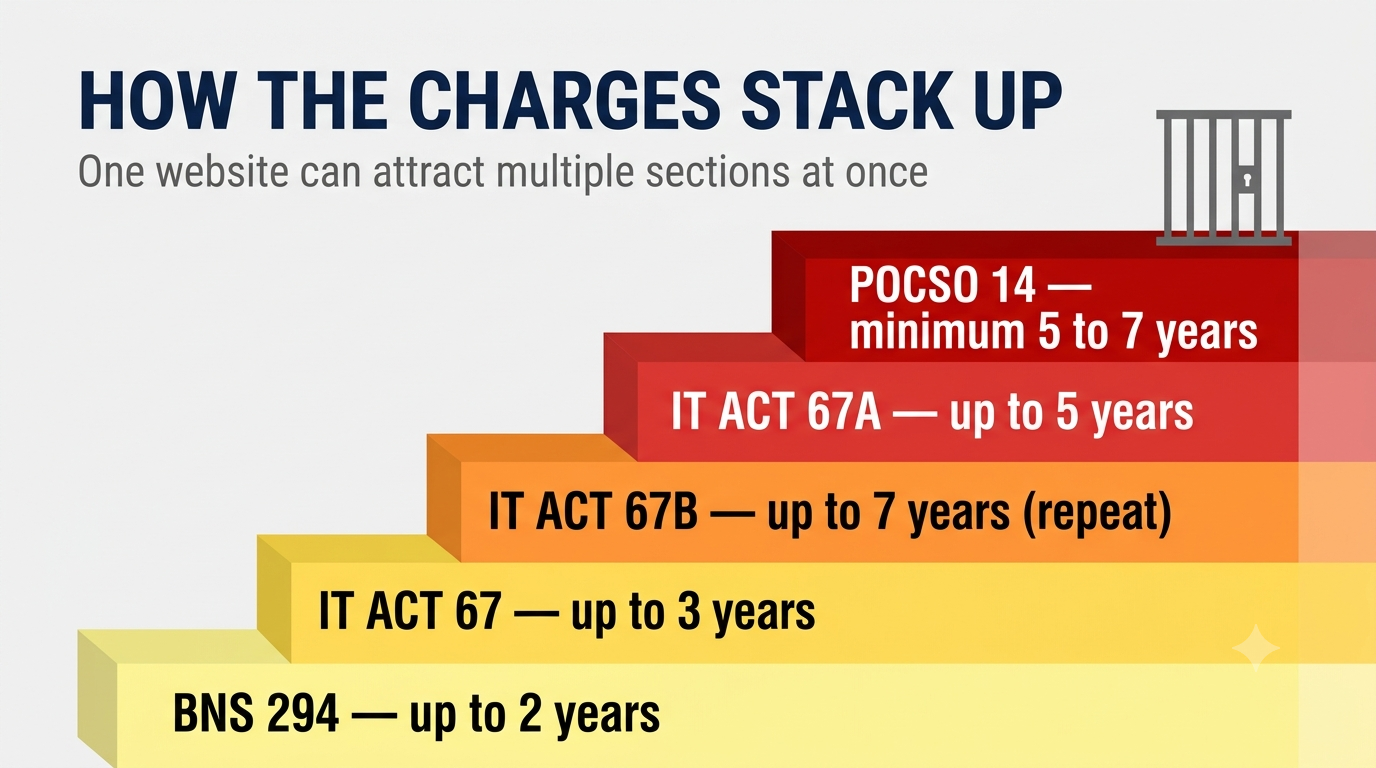
| IT Act 67 | Obscene content | Up to 3 yrs + ₹5 lakh | Up to 5 yrs + ₹10 lakh | Bailable (first offence) |
| IT Act 67A | Sexually explicit content | Up to 5 yrs + ₹10 lakh | Up to 7 yrs + ₹10 lakh | Non-bailable |
| IT Act 67B | Child sexual abuse material | Up to 5 yrs + ₹10 lakh | Up to 7 yrs + ₹10 lakh | Non-bailable |
| POCSO 14 | Using a child for pornography | Min. 5 yrs + fine | Min. 7 yrs + fine | Non-bailable |
| POCSO 15(3) | Storing CSAM for commercial purpose | 3 to 5 yrs | 5 to 7 yrs | Non-bailable |
| BNS 294 | Sale, distribution, exhibition of obscene material | Up to 2 yrs + ₹5,000 | Up to 5 yrs + ₹10,000 | Bailable |
| IRW Act 6 | Indecent representation of women | Up to 2 yrs + ₹2,000 | 6 months to 5 yrs | Bailable |
These punishments add up. A single adult website can be booked under IT Act 67A, BNS 294 and the IRW Act at once. If even one piece of child content is found on the server, add IT Act 67B and POCSO 14 and 15, with mandatory minimum jail terms.
"I Only Wrote the Code": Why Developers Are Held Liable
This is the part most developers do not want to hear.
1. You "caused" it to be published
Sections 67, 67A and 67B all punish the person who causes content to be published or transmitted. Building the platform, writing the upload and streaming logic, buying the domain and deploying the server is exactly that.
2. Safe harbour does not protect the owner
Section 79 of the IT Act gives "safe harbour" to intermediaries, meaning platforms are not liable for what their users upload. But that protection disappears if the platform:
- Conspired, abetted, aided or induced the unlawful act, or
- Got actual knowledge of unlawful content (for example, through a court or government order) and failed to remove it quickly
A website built for adult content, where the owner chooses, curates or uploads the material, is not a neutral intermediary. Safe harbour was designed for platforms like YouTube or Google Drive dealing with unlawful uploads they did not know about. It was never meant to protect a site whose entire business is the illegal content.
3. Faster takedown rules leave no room for "I didn't know"
From 20 February 2026, the amended IT Rules require intermediaries to remove non-consensual intimate imagery, including deepfake nudity, within 2 hours of a complaint, and other unlawful content within 3 hours of a court or government order. A platform that cannot meet these timelines loses safe harbour protection.
4. Freelancers and agencies are not automatically safe
If a client asks you to build an adult content platform, being "just the developer" does not guarantee protection. Indian criminal law also punishes abetment, which includes intentionally helping someone commit an offence. A developer who knowingly builds and maintains the infrastructure for an illegal site can be named in the FIR and dragged into the case. Even if you are eventually cleared, the investigation, device seizure and court dates can take years of your life.
5. Company structure does not shield you
Registering a company does not help. Section 85 of the IT Act says that when a company commits an offence, every person in charge of and responsible for its business is also treated as guilty, unless they can prove the offence happened without their knowledge or that they took all due care to prevent it.
What About Hosting Abroad or Using Fake Details?
Many people believe that hosting on Vercel, Render or an offshore server, or using a foreign Gmail, a US phone number or a VPN, puts them out of reach of Indian law. It does not.
- If you are in India and running the site from here, the offence is committed in India.
- Section 75 of the IT Act extends the Act to offences committed outside India if they involve a computer system located in India, and Indian users accessing your site are exactly that.
- Hosting providers, domain registrars, payment processors and email providers all keep logs and respond to lawful requests from investigating agencies.
We explain exactly how this tracing works in two dedicated articles:
- Can You Hide a Porn Website on Vercel, Render or Offshore Servers? How Indian Police Trace Website Owners
- Using a Foreign Gmail, US Phone Number or VPN to Run a Porn Website From India? Why You Will Still Be Caught
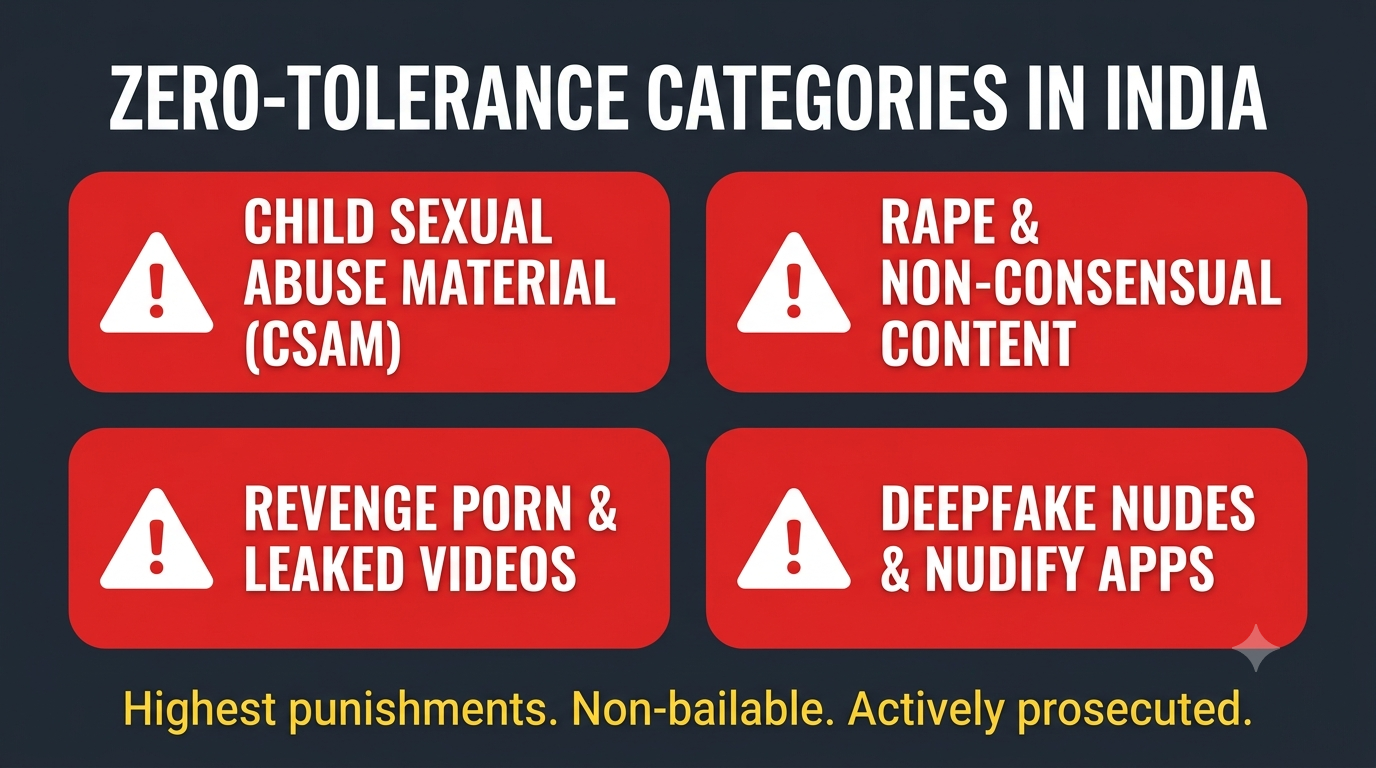
The Most Serious Categories: Where There Is Zero Tolerance
Not all illegal content is treated equally. Courts and police treat these categories as the most serious, and they come with the harshest punishments and the least sympathy:
- Child pornography / CSAM, including drawn, animated and AI-generated depictions of minors. IT Act 67B plus POCSO, with minimum jail terms.
- Rape videos and "forced" or non-consensual content. Beyond the IT Act, the people who record or circulate such content can face charges linked to the underlying sexual offence.
- Revenge porn and leaked private videos. Sharing someone's intimate images without consent attracts the IT Act's privacy and obscenity sections and BNS provisions on voyeurism and insulting a woman's modesty.
- Deepfake nudes and "nudify" apps. Covered by the 2026 IT Rules amendments, the IT Act and BNS, with a 2-hour takedown window.
We cover these in Rape Videos, "Forced" Porn, Revenge Porn and Deepfake Nudify Apps: Why Developers Who Build or Host Them Go to Jail in India.
"But I Was Only Going to Earn From Ads"
Ad revenue does not make the business legal. It makes it commercial, which is worse:
- Under BNS 294, receiving profits from an obscene-content business is itself part of the offence.
- Under POCSO Section 15(3), storing child sexual abuse material for a commercial purpose carries 3 to 5 years for a first conviction.
- Every rupee that reaches your bank account creates a money trail pointing straight back to you.
Read the full breakdown in Can You Earn Money From Ads on an Adult Website in India? The Legal and Financial Truth for Developers.
Real Consequences, Not Just Theory
These laws are actively enforced. To take one example, in February 2023, Kerala Police carried out simultaneous statewide raids under their Operation P-Hunt drive against child sexual exploitation material, registering 142 cases, arresting 12 people and seizing 270 devices. Police said the people arrested included young professionals and tech workers.
For a full list of documented arrests and convictions, read Real Arrests in India for Running Porn Websites and Sharing Illegal Content: Cases That Prove the Law Is Enforced.
Key Takeaways for Developers
- Watching adult porn privately is not a crime. Building, hosting or running a porn website is.
- IT Act 67A alone carries up to 5 years and ₹10 lakh, and it is non-bailable.
- Anything involving minors, including cartoons, anime and AI images, brings in IT Act 67B and POCSO, with minimum jail terms.
- The Supreme Court has ruled that even watching, storing or failing to report child sexual abuse material is an offence.
- "I only wrote the code" does not work. The law punishes whoever causes content to be published, and abetment is a crime too.
- Safe harbour does not protect a platform built for illegal content.
- Hosting abroad or using foreign accounts does not take you out of Indian jurisdiction.
Your skills as a developer are valuable. Use them to build products that you can proudly put on your resume, show to an employer, and talk about in an interview, not ones that end with a police knock at your door.
Disclaimer: This article is for general awareness and educational purposes only and does not constitute legal advice. Laws and their interpretation can change. For advice on a specific situation, consult a qualified lawyer.
Sources
- Section 67B, IT Act, 2000 — Indian Kanoon
- Section 77B, IT Act, 2000 — Income Tax Department of India
- POCSO (Amendment) Act, 2019 — Ministry of Women and Child Development
- Awareness Programme on Child Sexual Abuse and POCSO Act — PIB
- Indecent Representation of Women (Prohibition) Act, 1986 — India Code
- Just Rights for Children Alliance v. S. Harish (2024) — Indian Kanoon
- Supreme Court holds viewing and storing child pornography punishable — Supreme Court Observer
- Watching pornography in private not an offence under Section 292 IPC — SCC Online
- MeitY notifies the IT Amendment Rules 2026 — Khaitan & Co
- Kerala: 12 arrested in child porn crackdown — Deccan Herald
- Suhas Katti v. Tamil Nadu — Wikipedia
- #porn laws india
- #it act section 67
- #section 67a
- #section 67b
- #pocso act
- #developer legal guide
- #bns section 294
- #web development ethics
- #csam laws
❓ FAQs
Comments
Join the conversation
Login to post comments and replies
No comments yet. Be the first!