Web DevelopmentCyber Law for DevelopersOnline Safety
Building Any Platform That Hosts Child Pornography (CSAM) in India: Laws, Jail Terms and Why Developers and Owners Are Held Liable
A complete guide to child pornography (CSAM) laws in India for developers and platform owners. Learn the jail terms under POCSO Sections 14 and 15 and IT Act Section 67B, why the Supreme Court says viewing and downloading are crimes, how AI and anime content is covered, how CSAM reports reach Indian police through NCMEC and NCRB, and what real CBI crackdowns like Operation Carbon and Megh Chakra reveal.

MetaSkillGroup
18 min read10
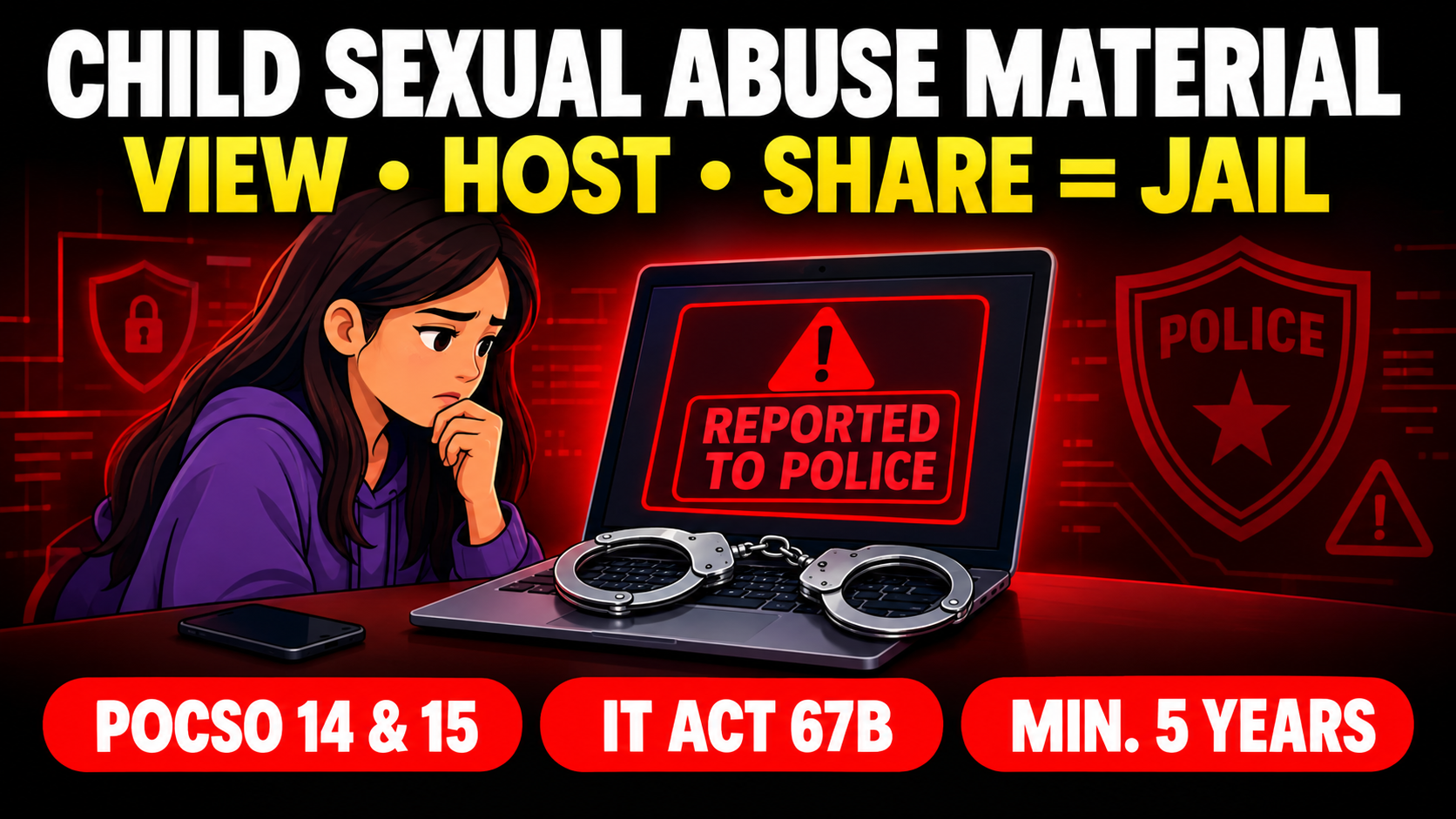
Quick answer: In India, creating, uploading, hosting, sharing, downloading, viewing or even failing to report child pornography / child sexual abuse material (CSAM) is a crime. Under POCSO Section 14, using a child for pornographic purposes carries a minimum of 5 years in jail (7 years on repeat). Under POCSO Section 15(3), storing it for commercial purposes carries 3 to 5 years, and under IT Act Section 67B, publishing, browsing or downloading it carries up to 5 years and ₹10 lakh (7 years on repeat). Drawn, animated and AI-generated images are covered. Developers and owners of platforms that host it can be prosecuted directly.
Last updated: October 2026
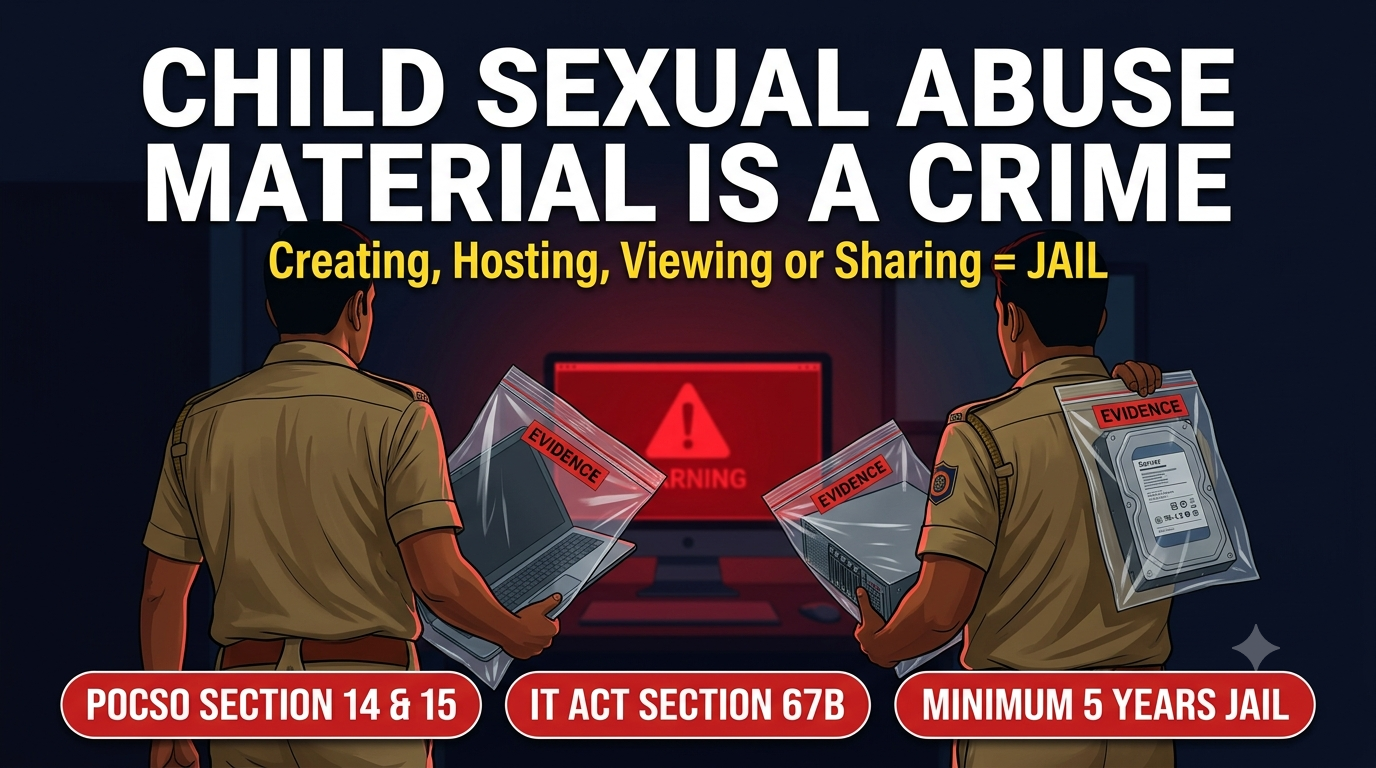
This is the most serious category of illegal online content in India, and it is the one where the law shows no flexibility at all. There is no "private viewing" defence, no "it was only a cartoon" defence, and no "I only built the platform" defence.
If you are a developer, this matters to you even if you would never go near such content. Any product that lets users upload, store, share or generate images and videos, whether it is a file-sharing app, a chat app, a forum, a cloud storage tool, a video platform or an AI image generator, can be misused to spread child sexual abuse material. How you build and run that product decides whether the law treats you as a responsible platform or as an accused.
This article is part of our series Running an Adult Website in India as a Developer: Laws, Punishments, Real Arrests and Why You Will Get Caught. For the full section-by-section breakdown of all porn-related laws, read Porn Laws in India Every Developer Must Know.
What Counts as Child Pornography (CSAM) Under Indian Law?
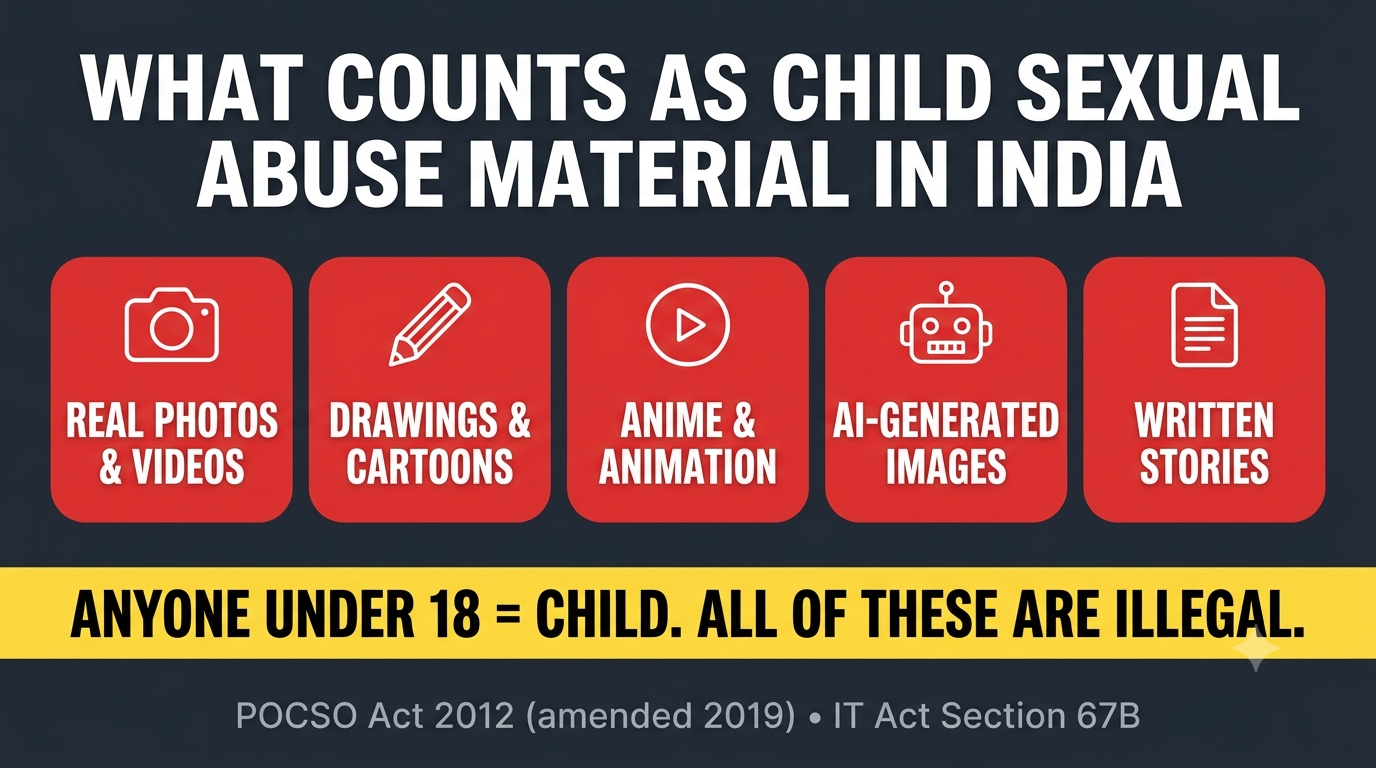
Any visual or written depiction of a person under 18 in sexually explicit conduct, whether real, drawn, animated or computer-generated, is treated as child pornography under Indian law.
The POCSO definition
The POCSO (Amendment) Act, 2019 added a formal definition of child pornography to the POCSO Act. It covers any visual depiction of sexually explicit conduct involving a child, including:
- Photographs and videos
- Digital or computer-generated images that are indistinguishable from a real child
- Images that are created, adapted or modified so that they appear to depict a child
A child means anyone below 18 years of age. It does not matter what the person "looks like", what the platform's terms of service say, or what the content is labelled as.
The IT Act covers text and drawings too
Section 67B of the IT Act goes even further. It covers anyone who creates "text or digital images" depicting children in an obscene, indecent or sexually explicit manner. That means:
- Anime, hentai and cartoons showing minors sexually are covered
- AI-generated images of minors in sexual situations are covered
- Written stories that sexually depict children are covered
"It's not a real child" is not a defence in India. The law targets the depiction itself, because such material normalises the abuse of children and is used to groom real victims.
Why the Supreme Court prefers "CSEAM"
In 2024, the Supreme Court asked courts across India to stop using the phrase "child pornography" and recommended the term Child Sexual Exploitative and Abuse Material (CSEAM), because "pornography" wrongly suggests consent. Every such image or video is a record of a child being abused. The court also asked Parliament to consider amending the POCSO Act to replace the term. In this article we use child pornography, CSAM and CSEAM interchangeably, because people search using all three.
Every Action Linked to CSAM Is a Crime
People often assume only the person who records or uploads such material is punished. That is wrong. Indian law criminalises almost every step in the chain.
| What you do | Law | Punishment (first conviction) |
|---|---|---|
| Use a child to create such material | POCSO Section 14(1) | Minimum 5 years + fine (minimum 7 years on repeat) |
| Directly take part in sexual assault while creating it | POCSO Section 14(2) + assault sections | Assault punishment added on top, up to life imprisonment |
| Publish, upload or transmit it | IT Act Section 67B(a) | Up to 5 years + up to ₹10 lakh |
| Create, collect, seek, browse, download, advertise, promote, exchange or distribute it | IT Act Section 67B(b) | Up to 5 years + up to ₹10 lakh |
| Store it with intent to share, or fail to delete, destroy or report it | POCSO Section 15(1) | Fine of at least ₹5,000 (at least ₹10,000 on repeat) |
| Store it to transmit, display or distribute | POCSO Section 15(2) | Up to 3 years, or fine, or both |
| Store it for commercial purposes (ads, subscriptions, sales) | POCSO Section 15(3) | 3 to 5 years (5 to 7 years on repeat) |
| Groom or entice children online, or facilitate their online abuse | IT Act Section 67B(c), (d) | Up to 5 years + up to ₹10 lakh |
On a repeat conviction, Section 67B goes up to 7 years. Section 67B and POCSO Sections 14 and 15 are cognizable and non-bailable, meaning police can arrest without a warrant and bail is entirely at the court's discretion.
Notice the commercial line. The moment a platform earns money, through ads, paid memberships, premium downloads or even donations, POCSO Section 15(3) comes into play, with a minimum sentence of 3 years.
The Supreme Court's 2024 Judgment: Watching and Downloading Are Crimes
What happened in the case?
In January 2020, Chennai police received information that a 28-year-old man had downloaded child sexual abuse videos on his phone. Forensic analysis confirmed the files had been stored on his device. He was charged under Section 67B of the IT Act and Section 15(1) of POCSO.
The Madras High Court quashed the case in January 2024, saying that merely downloading and watching such material, without sharing it, was not an offence.
What did the Supreme Court decide?
On 23 September 2024, in Just Rights for Children Alliance v. S. Harish, the Supreme Court set aside the High Court's ruling and restored the criminal case. The key points:
- Viewing, downloading and storing are offences. Section 67B is a comprehensive provision that punishes not only distribution but also the creation, possession, propagation and consumption of such material.
- Constructive possession counts. If you have control over the material, such as being able to view it online, that is possession, even if you never save the file.
- Deleting it does not save you. If you stored or watched it at any point, you can still be prosecuted, even if you deleted it before the FIR was registered.
- Not reporting it is evidence of intent. Under POCSO Section 15(1), failing to delete or report such material can itself show an intention to share it.
- "Automatic downloads" is not an excuse. Users are responsible for what is stored on their devices.
Bottom line from the Supreme Court: There is no such thing as "just watching" when it comes to child sexual abuse material. Every view creates demand for more abuse of real children.
Why Developers and Platform Owners Are Held Liable
This is where the law becomes directly relevant to your work as a developer. There are three very different situations.
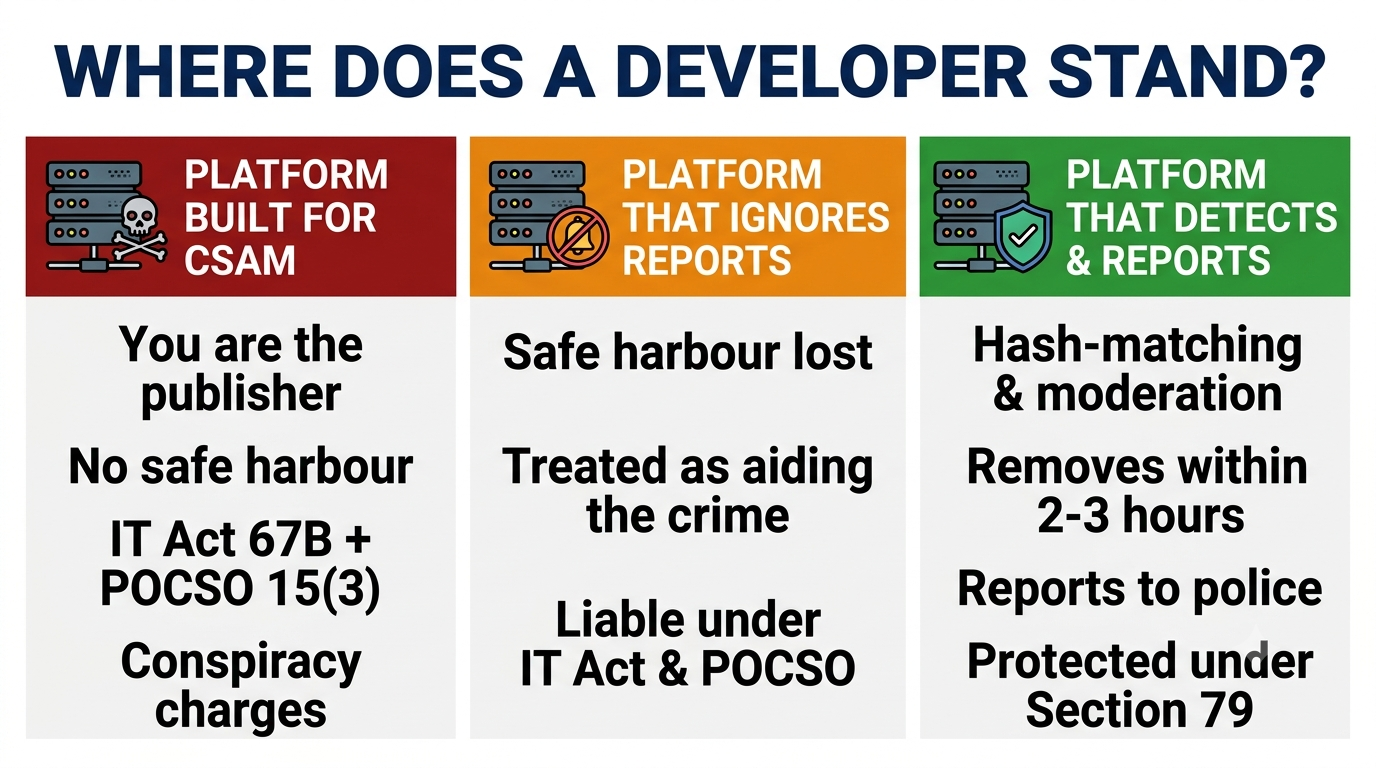
Situation 1: You build a platform meant for such content
If you build, host or run a website, Telegram bot, app or "private group" system whose purpose is to share or sell such material, you are not a developer in the eyes of the law. You are the publisher and distributor. You face, at minimum:
- IT Act 67B for publishing and distributing
- POCSO 15(2) and 15(3) for storage for distribution and commercial purposes
- Criminal conspiracy charges along with everyone else involved
- Section 85 of the IT Act, which makes every person in charge of a company liable for offences committed by it
There is no safe harbour, no "users uploaded it" defence, and no sympathy from any court.
Situation 2: You build a general platform where users upload content
Most developers fall into this category: file sharing, chat, social, forums, cloud storage, video hosting, community apps. Here the law gives you conditional protection.
Section 79 of the IT Act protects intermediaries from liability for user content, but only if:
- You did not conspire, abet, aid or induce the offence
- You remove or disable access quickly once you get actual knowledge through a court order or government notice, without destroying the evidence
- You follow the due diligence duties in the IT Rules
Under the IT Rules, 2021 (as amended in 2026):
- Platforms must act on government or court takedown orders within 3 hours
- Complaints about non-consensual sexual imagery must be acted on within 2 hours
- Significant social media intermediaries must deploy technology-based measures, including automated tools, to proactively identify child sexual abuse material (Rule 4(4))
- Platforms that offer AI generation tools must deploy reasonable technical measures to stop users from generating or spreading CSAM
If you ignore abuse reports, delete evidence, or design your platform so that nobody can report illegal content, you lose this protection. At that point you can be treated as having aided the offence.
Situation 3: You build an AI image or "character" generator
AI image tools are the fastest-growing source of this problem worldwide. In 2025, the US-based National Center for Missing & Exploited Children (NCMEC) received over 1.5 million reports with a connection to generative AI, including over 30,000 reports of people trying to generate CSAM through prompts and over 7,000 reports of people creating or possessing AI-generated CSAM.
If you build or fine-tune an image model, a "character chat" app or an "uncensored" generator and do not block sexual content involving minors, your product is a CSAM factory. Under POCSO's definition, computer-generated images that appear to depict a child are covered, and under IT Act 67B, creating digital images of children in sexually explicit acts is an offence.
The duty to report
Section 20 of POCSO requires personnel of media, studios and photographic facilities who come across sexually exploitative material involving children, through any medium, to report it to the Special Juvenile Police Unit (SJPU) or the local police. Under Section 21, failing to report can mean up to 6 months in jail, and a person in charge of a company or institution who fails to ensure reporting can face up to 1 year in jail and a fine.
Combined with POCSO Section 15(1), which punishes failing to report or delete such material, the message is clear: if CSAM appears on your platform, silently deleting it and moving on is not enough. It must be reported.
How People Get Caught: The Reporting Pipeline
Many people believe that using a VPN, a private Telegram group or an encrypted cloud drive keeps them hidden. Here is how the system actually works.
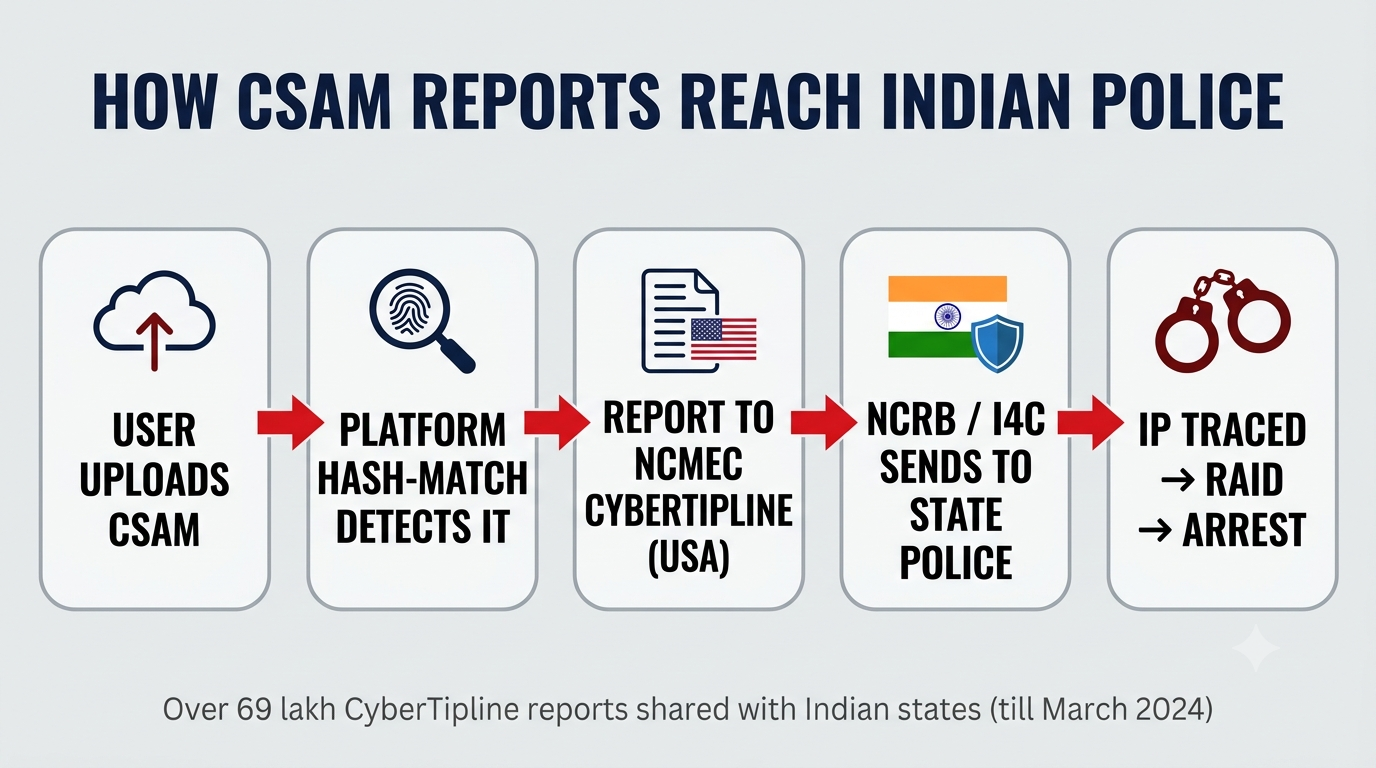
1. Platforms detect and report automatically
Large platforms scan uploads against databases of known child sexual abuse material using hash-matching technology. When a match is found, the account is reported. US-based companies are legally required to report such content to NCMEC's CyberTipline, along with details such as the uploader's IP address, email address, phone number and upload time.
NCMEC received 21.3 million CyberTipline reports in 2025 alone, covering more than 61.8 million images, videos and other files.
2. Reports reach Indian police
On 26 April 2019, India's National Crime Records Bureau (NCRB) signed an MoU with NCMEC to receive CyberTipline reports involving Indian users. According to the government's statement in the Rajya Sabha, more than 69 lakh CyberTipline reports had been shared with States and Union Territories for action as of 31 March 2024.
In September 2026, Meta announced that it will report child safety matters directly to India's cybercrime portal run by the Indian Cyber Crime Coordination Centre (I4C) under the Ministry of Home Affairs, making the pipeline even faster.
3. International police share leads
India also receives intelligence through Interpol. Investigators in other countries who infiltrate abuse-sharing groups pass on details of Indian members to the CBI.
4. Police raid, seize devices and run forensics
Once the IP address and account details are mapped to a real person, police raid the location, seize phones, laptops, hard drives and memory cards, and run forensic analysis. As the Supreme Court made clear, deleted files recovered in forensics can still be used to prosecute you.
Real Nationwide Crackdowns in India
These are not one-off arrests. Central and state agencies run coordinated operations specifically targeting child sexual abuse material.
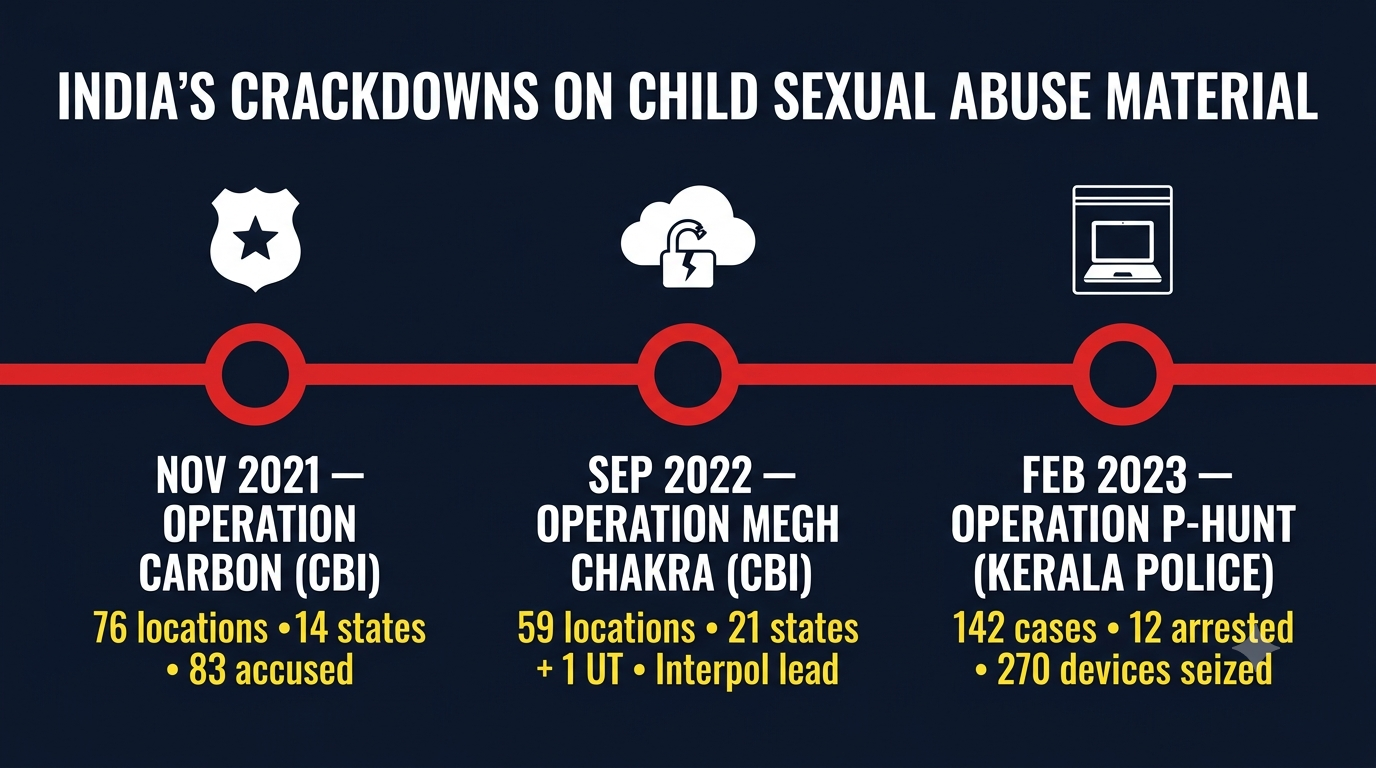
Operation Carbon: CBI, November 2021
On 14 and 15 November 2021, around Children's Day, the CBI registered 23 cases against 83 accused and searched 76 locations across 14 states, including Uttar Pradesh, Delhi, Punjab, Bihar, Rajasthan, Maharashtra, Gujarat, Haryana and Himachal Pradesh. The CBI said it had identified more than 50 groups with over 5,000 offenders sharing such material through social media groups and third-party hosting platforms, with members from around 100 countries. Electronic devices were seized, and the accused were booked under IT Act 67B and criminal conspiracy.
Operation Megh Chakra: CBI, September 2022
On 24 September 2022, the CBI searched 59 locations across 21 states and 1 Union Territory, including Uttarakhand, Uttar Pradesh, Haryana, Gujarat, West Bengal, Maharashtra and Karnataka. The operation targeted people sharing child sexual abuse material through cloud storage, which is why it was named "Megh Chakra" (cloud cycle). The leads came from New Zealand Police through Interpol's Crimes Against Children unit in Singapore. Phones and laptops of more than 50 suspects were seized, and preliminary forensics reportedly found large amounts of such material on several devices.
Read that again: the people who thought cloud storage kept them hidden were found because police in another country passed their details to India.
Operation P-Hunt: Kerala Police, February 2023
On 26 February 2023, Kerala Police's Countering Child Sexual Exploitation (CCSE) team ran simultaneous statewide raids under P-Hunt 23.1, after identifying around 858 locations. They registered 142 cases, arrested 12 people and seized 270 devices. Police said those arrested included young professionals and tech workers.
For more cases, read Real Arrests in India for Running Porn Websites and Sharing Illegal Content: Cases That Prove the Law Is Enforced.
Common Myths Developers Believe (and Why They Are Wrong)
| Myth | Reality |
|---|---|
| "It's anime or AI, not a real child." | IT Act 67B covers text and digital images. POCSO covers computer-generated images that appear to depict a child. |
| "I only watched it, I never shared it." | The Supreme Court held in 2024 that viewing, downloading and storing are offences. |
| "I deleted it, so there's no evidence." | Forensics recovers deleted files, and the Supreme Court said deletion does not erase liability. |
| "I used a private Telegram group / cloud drive." | Operation Megh Chakra caught people using cloud storage through an Interpol lead. |
| "Users uploaded it, not me." | Safe harbour is lost if you aid the offence, ignore reports or fail to act on orders. |
| "My platform is free, so it's not commercial." | Ads, memberships, donations and premium features can all count as commercial purpose under POCSO 15(3). |
What a Responsible Developer Must Build Into Any Upload Platform
If your app, website or SaaS product lets users upload or generate images, videos or files, treat child safety as a core feature, not an afterthought.
- Hash-matching on uploads. Use established detection technology that compares uploads against known abuse material, and block matches automatically.
- A visible "Report" button on every piece of user content, with a dedicated category for child sexual abuse.
- A grievance officer and published contact details, as required under the IT Rules.
- Fast takedown workflows that can meet the 2-hour and 3-hour timelines.
- Preserve evidence, then report. Disable access to the content, preserve the data securely as required by law, and report it to the police. Do not just silently delete it.
- Hard blocks in AI generation tools against any sexual content involving minors, including prompt filtering and output scanning.
- Logs and audit trails for moderation actions, so you can show the platform acted responsibly.
Building these features protects children, and it is also the only thing that keeps you protected under Section 79.
What to Do If You Come Across Such Material
- Do not download, screenshot, forward or "save as proof". Doing so can itself be an offence.
- Report it on India's National Cybercrime Reporting Portal at cybercrime.gov.in, which has a dedicated option for reporting crimes against women and children, including anonymous reporting.
- If you know a child is in danger, contact the local police or Childline (1098).
- If it is on a platform, use the platform's report feature as well.
Key Takeaways
- Anyone under 18 is a child. Any sexual depiction of them, real, drawn, animated or AI-generated, is illegal.
- Using a child for pornography = minimum 5 years under POCSO Section 14.
- Viewing, downloading and storing are offences, as confirmed by the Supreme Court in 2024.
- Commercial storage = 3 to 5 years minimum under POCSO Section 15(3).
- Platforms that ignore reports or delete evidence lose safe harbour under Section 79.
- Reports flow from global platforms to NCMEC, then to NCRB / I4C, and then to your state police. Over 69 lakh such reports had been shared with Indian states by March 2024.
- The CBI and state police run nationwide raids specifically for this crime.
If you are building any product where users can upload or generate content, build child safety in from day one. If you ever see this material anywhere, report it. Do not look away, and do not look further.
Read the full series
- Running an Adult Website in India as a Developer: Laws, Punishments, Real Arrests and Why You Will Get Caught
- Porn Laws in India Every Developer Must Know: IT Act 67, 67A, 67B, POCSO and BNS Punishments Explained Section by Section
- Rape Videos, "Forced" Porn, Revenge Porn and Deepfake Nudify Apps: Why Developers Who Build or Host Them Go to Jail in India
- Real Arrests in India for Running Porn Websites and Sharing Illegal Content: Cases That Prove the Law Is Enforced
- Can You Hide a Porn Website on Vercel, Render or Offshore Servers? How Indian Police Trace Website Owners
- Using a Foreign Gmail, US Phone Number or VPN to Run a Porn Website From India? Why You Will Still Be Caught
- Can You Earn Money From Ads on an Adult Website in India? The Legal and Financial Truth for Developers
Disclaimer: This article is for general awareness and educational purposes only and does not constitute legal advice. Laws and their interpretation can change. For advice on a specific situation, consult a qualified lawyer. If you have information about a child being abused, report it immediately to the police or at cybercrime.gov.in.
Sources
- Just Rights for Children Alliance v. S. Harish (2024) — Indian Kanoon
- Supreme Court holds viewing, storing and possessing child pornography punishable — Supreme Court Observer
- SC says watching child pornography in private is crime under POCSO — News On AIR
- POCSO (Amendment) Act, 2019 — Ministry of Women and Child Development
- Awareness Programme on Child Sexual Abuse and POCSO Act — PIB
- Section 67B, IT Act, 2000 — Indian Kanoon
- Section 20, POCSO Act — Barristery
- Rule 4, IT (Intermediary Guidelines) Rules, 2021 — Indian Kanoon
- MeitY notifies the IT Amendment Rules 2026 — Khaitan & Co
- The Work Never Stops: A First Look at NCMEC's 2025 Data — NCMEC
- Meta Will Report Child Safety Matters Directly to India's I4C — MediaNama
- CBI files 23 cases against 83 accused for sharing child sexual abuse material online — The News Minute
- Massive CBI crackdown against circulation of child sex abuse material — The Tribune
- Kerala: 12 arrested in child porn crackdown — Deccan Herald
- #child pornography law india
- #csam laws india
- #pocso act
- #it act section 67b
- #supreme court csam judgment
- #platform liability
- #developer legal guide
- #cyber law india
- #child safety online
- #ai generated csam
❓ FAQs
Comments
Join the conversation
Login to post comments and replies
No comments yet. Be the first!