Web DevelopmentDSADeveloper Careers
How to Prepare for an Internship Entrance Test in 2026 (With Sample MCQs)
A simple 2026 guide to preparing for an internship entrance test: what the aptitude, DSA and track-skill sections look like, a 2-week study plan, 10 sample MCQs with answers, speed tips for timed questions and an exam-day checklist for online tests.

MetaSkillGroup
13 min read3

You have found an internship you like, filled in the form, and now there is one step left: the entrance test. For many students this is the most stressful part. You may be wondering what kind of questions will come, how much time you will get, and what to study first.
Here is the good news: internship tests for students are made to check your basics, not to trick you. With two weeks of focused practice, you can walk in calm and confident. This guide shows you how a typical test looks, gives you a day-by-day plan, and ends with sample MCQs you can try right now.
💡 Quick answer: Most internship entrance tests have three parts: general aptitude, DSA and maths basics, and questions on the skills of your track. Prepare for two weeks: take one practice test to find your weak areas, practise 20–30 timed MCQs a day, revise your track's basics, and check your laptop, webcam and internet the day before.
💡 Who is this guide for? College students and freshers preparing for an online internship test, especially for web development and Python internships.
In this guide:
- What Is an Internship Entrance Test?
- What a Typical Test Looks Like
- A 2-Week Preparation Plan
- How to Prepare for the Aptitude Section
- How to Prepare for DSA and Maths
- How to Prepare for Your Track's Skills
- 10 Sample MCQs With Answers
- Speed Tips for Timed MCQs
- Your Exam-Day Checklist
- How the MetaSkillGroup Entrance Exam Works
- Common Mistakes to Avoid
What Is an Internship Entrance Test?
An internship entrance test is a short online test that a company uses to check your basics before it offers you an internship. Companies receive many applications, and a test is a fair way to see who already knows the fundamentals of the role.
Tests come in a few common formats:
| Format | What happens | How to prepare |
|---|---|---|
| MCQ test | Multiple-choice questions with a timer | Timed MCQ practice |
| Coding test | You solve 1–3 small programming problems | Easy problems on arrays and strings |
| Take-home task | You build a small feature in a few days | Small projects in your track |
| Short interview | A 15–30 minute call about your basics and projects | Explain your own projects out loud |
Many companies use a mix, but the MCQ test is the most common first step for student internships, so this guide focuses on it.
What a Typical Test Looks Like
A typical internship MCQ test has three sections. The exact number of questions changes from company to company, but the pattern stays the same.
| Section | What it checks | Common topics |
|---|---|---|
| General aptitude | Logic and quick thinking | Percentages, ratios, series, speed and time, puzzles |
| DSA and maths | Problem-solving basics | Arrays, strings, Big-O, stacks and queues, number systems |
| Track skills | The skills of the role | HTML, CSS, JavaScript, React, Node.js, Python, SQL |

Figure 1: The three sections you will see in most internship MCQ tests.
Since the track section is usually the largest, it carries the most marks. Your track skills deserve the biggest share of your preparation time.
A 2-Week Preparation Plan
Two weeks is enough if you study for 2–3 hours a day and practise with a timer.
| Days | Focus | Daily practice |
|---|---|---|
| Day 1–2 | Understand the format and take one full practice test | Write down your weak topics |
| Day 3–5 | Aptitude: percentages, ratios, series, speed and time | 30 timed MCQs a day |
| Day 6–8 | DSA and maths: arrays, strings, Big-O, stacks, binary numbers | 20 MCQs and 2 easy coding problems a day |
| Day 9–12 | Your track's skills | 30 MCQs a day and revise your notes |
| Day 13 | One full timed practice test | Review every wrong answer |
| Day 14 | Light revision and a setup check | Sleep early |

Figure 2: A simple 14-day plan. Practise with a timer from day one.
💡 Pro Tip: Keep a "mistakes notebook". Every time you get a question wrong, write the topic and the correct idea in one line. Read this notebook on day 14 instead of starting anything new.
How to Prepare for the Aptitude Section
Aptitude questions check how quickly and clearly you think. You do not need advanced maths, just class 10 level basics and a lot of practice.
Focus on these topics:
- Percentages, profit and loss: the base of many questions
- Ratios and averages: sharing, mixtures and ages
- Number series: find the pattern in the gaps between numbers
- Speed, time and distance: remember to multiply km/h by 5/18 to get m/s
- Time and work: if A finishes a job in 4 days, A does 1/4 of it each day
- Logical reasoning: coding-decoding, directions, simple puzzles
Practise with a timer from the start. In a real test you may get less than half a minute per question, so speed comes only from practice.
How to Prepare for DSA and Maths
This section checks whether you understand the basic building blocks of programming. You need concepts, not long code.
| Topic | What to know |
|---|---|
| Arrays and strings | Indexing, looping, reversing, finding the largest value |
| Big-O notation | O(1), O(log n), O(n), O(n log n) and O(n²), and what each one means |
| Stacks and queues | Stack = Last In, First Out; Queue = First In, First Out |
| Searching and sorting | Linear search, binary search, and the idea behind bubble and merge sort |
| Recursion | A function calling itself, with a base case |
| Number systems | Converting between decimal and binary |
Solve a few easy problems on a practice site such as LeetCode, HackerRank or GeeksforGeeks. Easy problems on arrays and strings are enough at this stage.
How to Prepare for Your Track's Skills
This is usually the biggest section, so revise the basics of the track you applied for. Here is what to focus on for common web development tracks:
| Track | Revise these topics |
|---|---|
| Frontend | HTML tags and forms, the CSS box model, Flexbox, Grid, JavaScript arrays and objects, the DOM, React hooks |
| Backend | Node.js basics, Express routes and middleware, HTTP methods and status codes, MongoDB queries |
| Full Stack | JavaScript or TypeScript, React, REST APIs, Node.js, MongoDB |
| MERN Stack | MongoDB, Express, React and Node.js, with strong JavaScript |
| MEAN Stack | TypeScript, Angular components and services, Node.js, Express, MongoDB |
| Python | Data types, lists and dictionaries, functions, OOP, Django or FastAPI basics, SQL |
If you are still building your basics, our frontend developer roadmap and MERN stack roadmap show what to learn and in which order.
💡 Pro Tip: Test questions often check small details, like the output of a line of code. Open your browser console or a Python shell and actually run the snippets you revise. Seeing the output yourself makes it stick.
10 Sample MCQs With Answers
Try these with a timer of 20 seconds each. They are practice questions written for this guide, at the level you can expect in a student internship test.
Aptitude
1. If 5 pens cost ₹60, how much do 8 pens cost?
A) ₹80 · B) ₹100 · C) ₹96 · D) ₹108
Answer: C) ₹96. One pen costs ₹60 ÷ 5 = ₹12, so 8 pens cost ₹12 × 8 = ₹96.
2. What comes next: 2, 6, 12, 20, 30, ?
A) 42 · B) 40 · C) 44 · D) 36
Answer: A) 42. The gaps are 4, 6, 8, 10, so the next gap is 12, and 30 + 12 = 42.
3. A train covers 180 km in 3 hours. What is its speed in metres per second?
A) 15 m/s · B) 18 m/s · C) 20 m/s · D) 16.67 m/s
Answer: D) 16.67 m/s. The speed is 60 km/h, and 60 × 5/18 = 16.67 m/s.
DSA and maths
4. What is the time complexity of binary search on a sorted array of n elements?
A) O(n) · B) O(n log n) · C) O(log n) · D) O(1)
Answer: C) O(log n). Binary search cuts the search area in half at every step.
5. Which data structure follows Last In, First Out (LIFO)?
A) Stack · B) Queue · C) Array · D) Graph
Answer: A) Stack. The last item pushed onto a stack is the first one taken off, like a pile of plates.
6. What is 13 in binary?
A) 1011 · B) 1110 · C) 1001 · D) 1101
Answer: D) 1101. 1101 = 8 + 4 + 0 + 1 = 13.
Track skills
7. Which CSS property lets flex items move onto the next line when there is not enough space?
A) flex-direction · B) flex-wrap · C) align-items · D) justify-content
Answer: B) flex-wrap. Setting flex-wrap: wrap lets the items wrap onto new lines.
8. What does [1, 2, 3].map(n => n * 2) return in JavaScript?
A) 12 · B) [1, 2, 3] · C) [2, 4, 6] · D) undefined
Answer: C) [2, 4, 6]. map returns a new array with each item doubled.
9. In React, which hook adds state that re-renders the component when it changes?
A) useEffect · B) useState · C) useRef · D) useMemo
Answer: B) useState. Calling its setter function updates the value and re-renders the component.
10. What does print(2 ** 3) print in Python?
A) 8 · B) 6 · C) 9 · D) 5
Answer: A) 8. In Python, ** means "to the power of", so 2 × 2 × 2 = 8.
How did you do? If you scored 7 or more in time, you are on the right track. If not, that is perfectly fine. Note the topics you missed and add them to your plan.
Speed Tips for Timed MCQs
In many online tests, every question has its own short timer. Knowing the answer is only half the job; you also need to answer quickly.
- Read the question first, then the options. Know what is being asked before you look at the choices.
- Remove the clearly wrong options. Going from four choices to two makes the decision much easier.
- Do not get stuck. If a question is taking too long, make your best choice and move on.
- Check whether there is negative marking. If there is none, never leave a question blank.
- Keep rough paper and a pen ready for maths questions, if the test rules allow it.
- Practise with the same timer as the real test, so the real thing feels normal.
Your Exam-Day Checklist
Online internship tests are often proctored, which means your webcam and screen may be monitored. A little setup the day before saves a lot of stress.
- Laptop or desktop fully charged, with the charger plugged in
- Webcam and microphone tested in your browser
- Stable internet; keep mobile data ready as a backup
- Latest version of Chrome or Edge, with extra tabs and apps closed
- A quiet, well-lit room where your face is clearly visible
- Notifications turned off on your laptop and phone
- Water nearby, and the test link and login details saved
⚠️ Note: Many proctored tests run in fullscreen and treat switching tabs or leaving fullscreen as a violation. Read the instructions on the start page carefully before you begin.
How the MetaSkillGroup Entrance Exam Works
If you are applying to our internship, here is exactly what our entrance exam looks like:
| Details | |
|---|---|
| Questions | 50 MCQs: 10 general aptitude, 10 DSA and maths, 30 on your track's skills |
| Time | 45 minutes, and each question has its own 15–25 second timer |
| Marks | 2 marks per question, 100 in total, with no negative marking |
| Device | Laptop or desktop only, in fullscreen, with your webcam on and your entire screen shared |
| When | You start within 72 hours of your exam being unlocked |
| Attempts | Your first attempt is free. Your second attempt is free after 15 days, or ₹99 if you want it straight away |
| Result | The free Unpaid Internship is open at any score, and 75% or more also unlocks the Paid Internship with a stipend |

Figure 3: Our entrance exam at a glance.
Since there is no negative marking, answer every question, even when you are not fully sure. Our free online internship guide explains the whole journey after the exam, from choosing your track to getting your certificate.
Common Mistakes to Avoid
- Studying without a timer. Knowing an answer slowly is very different from knowing it in 20 seconds.
- Ignoring the aptitude section. It is quick marks if you practise, and many students skip it.
- Learning new topics the night before. Use the last day to revise, not to start something new.
- Not testing your setup. A webcam or internet problem on exam day causes needless stress.
- Spending too long on one question. One hard question is never worth missing three easy ones.
- Panicking after a tough question. Every test has a few hard ones. Take a breath and move to the next.
If this is your first internship, our guide to getting a web development internship with no experience covers the full path, including projects and your resume.
Final Thoughts
An internship entrance test is not a wall; it is a door. It simply checks that you have the basics, and basics can be practised. Give yourself two focused weeks, practise with a timer, learn from every mistake, and set up your laptop the day before.
If you are ready to put that preparation to use, you can do a free internship at MetaSkillGroup. Our online developer internship is open all year in six tracks. It takes about 2 minutes to apply, and your first exam attempt is free.
- #internship entrance test
- #internship test preparation
- #aptitude test
- #mcq practice
- #internship for students
- #internship for freshers
- #online internship
- #free internship
Related posts
 Frontend Developer Roadmap 2026: A Step-by-Step Guide for BeginnersA simple, step-by-step frontend developer roadmap for 2026. Learn HTML, CSS, JavaScript, Git, React, TypeScript and Next.js in the right order, with a 6-month study plan, beginner projects, free resources and a checklist for your first frontend internship.
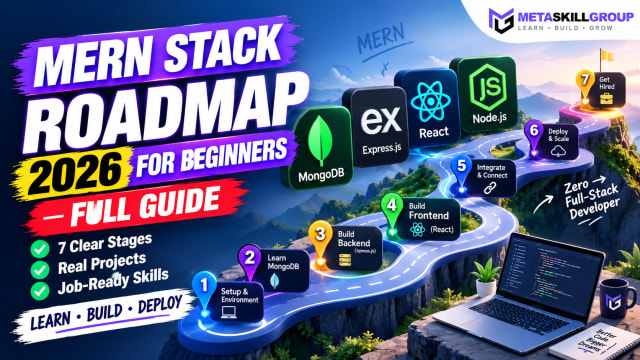 MERN Stack Roadmap for Beginners 2026: A Step-by-Step Guide to Becoming a Full-Stack DeveloperConfused about where to start with MERN? This step-by-step MERN stack roadmap for 2026 takes you from zero to your first full-stack project. Learn JavaScript, Node.js, Express, MongoDB and React in the right order, with a clear timeline, milestone projects, common mistakes and tips to learn faster with AI tools.
 How to Build a Website with AI Agents in 2026: A Step-by-Step GuideLearn how to build a website with AI agents in 2026, step by step. Compare tools like Lovable, v0, Bolt, Replit and Cursor, write prompts that actually work, test AI-generated code, optimize for SEO and publish your site live, even if you only know a little code.
❓ FAQs
Most tests have three parts: general aptitude (percentages, series, speed and time, logic), DSA and maths basics (arrays, strings, Big-O, stacks, number systems), and questions on the skills of your track, such as HTML, CSS, JavaScript, React or Python.
Two weeks of focused practice, 2–3 hours a day, is enough for most student internship tests if you already know your track's basics. Spend the most time on your weak areas and your track skills.
Revise class 10 level maths: percentages, ratios, averages, number series, speed and time, and time and work. Then practise 20–30 timed MCQs a day so that you can answer quickly.
Some do. Many student internships start with an MCQ test, while others add 1–3 easy coding problems or a small take-home task. Easy problems on arrays and strings are good preparation for both.
It depends on the company, so read the instructions first. If there is no negative marking, answer every question. The MetaSkillGroup entrance exam has no negative marking.
Many proctored tests need a laptop or desktop. The MetaSkillGroup entrance exam opens only on a laptop or desktop, in fullscreen, with your webcam on and your entire screen shared.
You can usually try again. At MetaSkillGroup your first attempt is free, and your second attempt is free after 15 days, or ₹99 if you want it straight away. The free Unpaid Internship is also open whatever you score.
Read the question before the options, remove the clearly wrong options, don't get stuck on one question, and practise with the same timer as the real test. Speed comes from regular timed practice.
Charge your laptop, test your webcam and microphone, use a stable internet connection, update your browser, close other tabs and apps, and sit in a quiet, well-lit room.
50 MCQs in 45 minutes: 10 on general aptitude, 10 on DSA and maths and 30 on your track's skills. Each question has its own 15–25 second timer, every question carries 2 marks and there is no negative marking.
Comments
Join the conversation
Login to post comments and replies
No comments yet. Be the first!